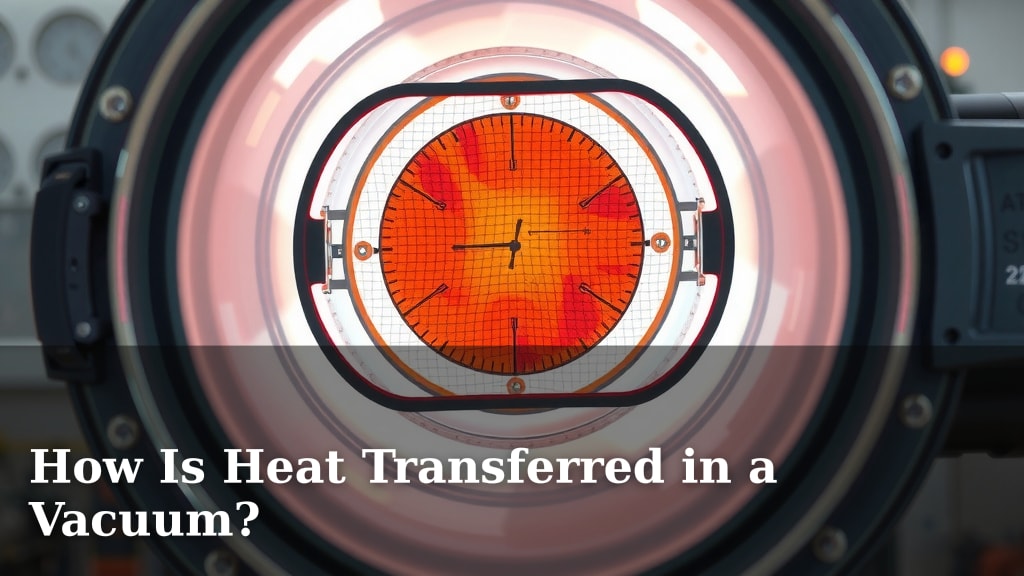
How Is Heat Transferred in a Vacuum?
Heat does not transfer directly in a vacuum because there are no particles to carry the energy. Instead, heat moves through a vacuum via electromagnetic radiation. Think of sunlight traveling through the vast emptiness of space to reach Earth – that’s radiation in action!
While conduction and convection need a medium (like solids, liquids, or gases) to work, radiation is a bit of a lone wolf. It can travel through empty space, making it the only way heat can get from one place to another when nothing is in between. This might seem a little mind-bending at first, but we’ve found it’s the core principle.
- Heat transfer in a vacuum relies on radiation.
- Direct contact (conduction) or fluid movement (convection) can’t happen.
- Electromagnetic waves carry the energy.
- Sunlight warming the Earth is a prime example.
Let’s dive into the fascinating science of how heat manages to cross the void without any help. We’ll break down exactly how this works step by step.
You might be wondering how something can get hot if there’s nothing to heat it up, especially in the vast emptiness of space. It’s a great question! Since there are no air molecules or other particles floating around in a vacuum, the usual ways heat travels – conduction and convection – just can’t happen. Think about it: conduction needs direct contact, and convection needs something to flow, like air or water. A vacuum is the ultimate “nothing,” so those methods are out.
Understanding Heat Transfer Through Empty Space
So, how does the sun warm up a satellite or astronauts in space? The answer is radiation. It’s the only way heat can cross a vacuum. We found that this process relies on something a bit different: electromagnetic waves.
What Exactly Are Electromagnetic Waves?
Electromagnetic waves are energy that travels in waves. They don’t need a medium, like air or water, to move. You can think of them like ripples on a pond, but instead of water, they’re traveling through space. These waves include light, radio waves, microwaves, and X-rays.
The Electromagnetic Spectrum
All these waves are part of the electromagnetic spectrum. The type of wave depends on its wavelength and frequency. Heat we feel from the sun is primarily infrared radiation, which is a part of this spectrum. It’s invisible to our eyes but we feel its warmth.
How Radiation Carries Heat
Objects that have a temperature above absolute zero emit thermal radiation. This radiation is in the form of electromagnetic waves. When these waves hit another object, they can be absorbed, reflected, or transmitted. If they are absorbed, the energy of the waves is converted into heat within the object, raising its temperature.
Emitting and Absorbing Radiation
The hotter an object is, the more radiation it emits. And the type of radiation emitted also changes with temperature. For example, a very hot object might emit visible light, while a cooler object emits mostly infrared radiation. When these waves encounter a surface, some energy is absorbed, warming the surface. Other waves might bounce off (reflection) or pass through (transmission), but absorption is key for heating.
Radiation vs. Conduction and Convection
Let’s quickly recap why radiation is the star player in a vacuum.
- Conduction: Needs direct contact. Think of touching a hot stove. Without particles touching, no heat transfer.
- Convection: Needs fluid movement (gas or liquid). Imagine boiling water; the hot water rises. No fluid, no convection.
- Radiation: Uses electromagnetic waves. These waves zip through empty space. This is how heat gets around in a vacuum.
Everyday Examples of Radiation in a Vacuum
You experience radiation from a vacuum more often than you might think. The most obvious example is right above your head!
The Sun and Earth
The sun is a giant ball of incredibly hot plasma, about 93 million miles away. The space between the sun and Earth is essentially a vacuum. Yet, the sun’s heat reaches us every single day. This is possible because the sun emits vast amounts of electromagnetic radiation, including infrared and visible light. These waves travel through the vacuum of space, and when they hit Earth’s atmosphere and surface, they are absorbed, warming our planet. We found that without radiation, Earth would be a frozen, lifeless ball.
Spacecraft and Satellites
Think about the satellites orbiting Earth or the probes traveling to distant planets. They are constantly exposed to the vacuum of space. Their temperature is regulated by a balance between the radiation they absorb from the sun and the heat they radiate away into space. Engineers must design spacecraft with special materials and coverings to manage this heat. They might use reflective surfaces to bounce away unwanted solar radiation or use materials that efficiently radiate excess heat away from sensitive components. This careful design is essential for their survival.
Campfires and Radiators
Even on Earth, radiation plays a role. When you sit near a campfire, you feel its warmth even if the air between you and the fire hasn’t warmed up much yet. That’s the infrared radiation from the fire reaching your skin. Similarly, a hot radiator in your home emits infrared radiation that warms the room. While conduction and convection also help distribute heat indoors, radiation is a direct heat transfer method that works even without air movement. This is why we found many experts emphasize understanding radiation for thermal comfort.
Factors Affecting Heat Transfer by Radiation
While radiation is powerful, its effectiveness depends on a few key things. It’s not a one-size-fits-all situation.
Surface Properties: Emissivity and Absorptivity
The nature of the surface plays a big role. Dark, matte surfaces are excellent emitters and absorbers of radiation. Think of a black T-shirt on a sunny day – it gets much hotter than a white one. This is because black surfaces have high emissivity (they radiate heat well) and high absorptivity (they soak up incoming radiation well). Shiny, metallic surfaces, on the other hand, are poor emitters and absorbers but are good reflectors. Space blankets, for instance, are shiny to reflect body heat back towards the wearer.
Temperature Difference
The rate at which heat is transferred by radiation is strongly dependent on the temperature difference between the objects. The greater the temperature difference, the faster the heat transfer. This is described by the Stefan-Boltzmann law, which states that the energy radiated per unit surface area is proportional to the fourth power of the absolute temperature. We found this relationship explains why objects at very high temperatures, like the sun, transfer so much energy.
Surface Area
A larger surface area allows for more radiation to be emitted or absorbed. This is why radiators in a home are often designed with fins to increase their surface area, allowing them to release heat more effectively into the room.
Distance
The intensity of radiation decreases with the square of the distance from the source. This means that as you move farther away from a radiating object, the amount of heat you receive drops off quickly. It’s like a flashlight beam – it’s brightest up close and spreads out, becoming dimmer the further away you get.

A Quick Checklist for Radiation in a Vacuum
Let’s quickly review the main points about heat transfer in a vacuum:
- Radiation is the only method of heat transfer in a vacuum.
- It uses electromagnetic waves, not particles.
- Objects above absolute zero emit thermal radiation.
- Absorption of these waves heats up an object.
- Surface properties (color, texture) greatly affect absorption/emission.
- Temperature difference and distance are key factors.
Conclusion
You’ve learned that heat doesn’t travel through a vacuum the way it does in your home. Radiation, using electromagnetic waves, is the only way heat can cross empty space. We found this principle is vital, from the sun warming Earth to keeping satellites functioning. Understanding radiation helps you see how objects far apart can still exchange heat energy. Keep an eye out for radiation in your daily life; it’s working all around you!
Frequently Asked Questions
Can an object in a vacuum ever get cold?
Yes, an object in a vacuum can get cold. While it absorbs radiation from its surroundings (like the sun), it also emits its own thermal radiation. If it’s radiating heat faster than it’s absorbing it, its temperature will decrease.
Does radiation from the sun stop when it hits the moon?
The sun’s radiation continues through space. The moon itself reflects some of this radiation, but it also absorbs it, which is why the side of the moon facing the sun can get very hot. The vacuum of space doesn’t stop these waves.
How do astronauts stay warm if there’s nothing to transfer heat to them?
Astronauts are inside a spacecraft that absorbs solar radiation. Their suits are designed to insulate them and manage heat. They also emit their own body heat as infrared radiation, which their suits help contain or vent as needed.
What happens to heat transfer if a vacuum isn’t perfect?
If a vacuum isn’t perfect and contains a few particles, some very limited conduction or convection might occur. However, radiation is still the dominant heat transfer method in near-vacuum conditions like space.
Are all electromagnetic waves heat radiation?
No, not all electromagnetic waves are felt as heat. While infrared radiation is directly associated with heat, other waves like visible light, radio waves, and X-rays carry energy but aren’t perceived as warmth by our skin unless absorbed and converted to heat.
![7 Best Corded Stick Vacuum For Bare Floors [2026]](https://bathroomexplorer.com/wp-content/uploads/2026/05/7-best-corded-stick-vacuum-for-bare-floors-2026-featured-768x432.jpg)


![7 Best Cordless Vacuum Cleaner For Hard Floors And Carpets [2026]](https://bathroomexplorer.com/wp-content/uploads/2026/05/7-best-cordless-vacuum-cleaner-for-hard-floors-and-carpets-2026-featured-768x432.jpg)