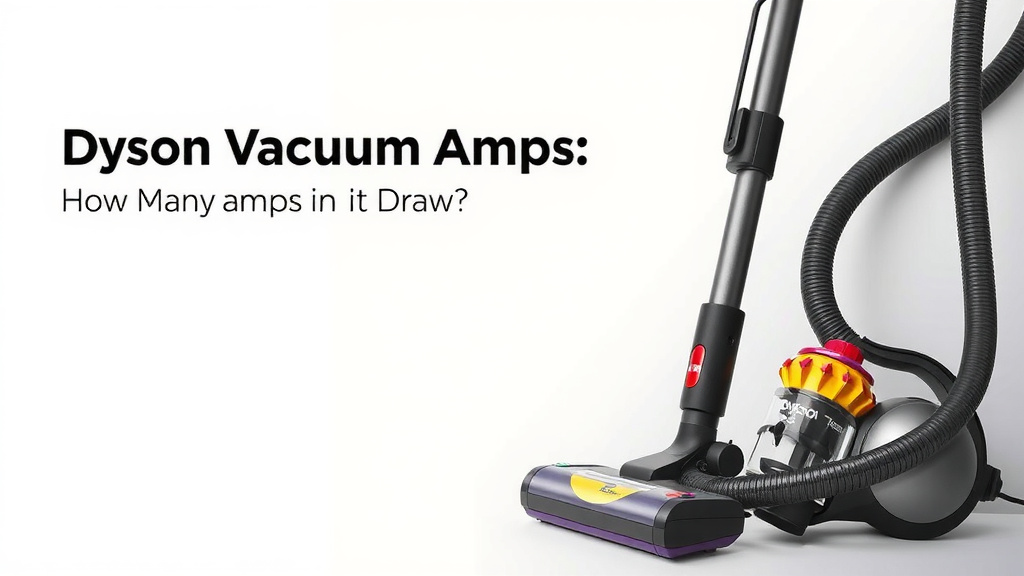
Dyson Vacuum Amps: How Many Does It Draw
A Dyson vacuum cleaner typically draws between 700 and 1,500 watts when operating at full power. This translates to roughly 6 to 12.5 amps, depending on the specific model and its power settings. So, you don’t need a special circuit for your Dyson; most standard home outlets can handle the load just fine.
Understanding the amperage of your vacuum helps you know its power consumption. It’s a good idea to know how much power your appliances use, especially if you’re running multiple devices at once. This information is usually found on the appliance’s rating plate.
- Dyson vacuums use about 700-1500 watts.
- This means they draw 6-12.5 amps.
- Standard home outlets are usually sufficient.
- Check the rating plate for exact numbers.
We’ve gathered the details on Dyson vacuum amperage, so let’s get into what that means for your home and how it compares across different models.
Understanding Your Dyson Vacuum’s Power Draw
You might be wondering about the electrical pull of your Dyson vacuum cleaner. It’s a common question, especially when you’re thinking about how much power your appliances use. Let’s break down how many amps a Dyson vacuum typically draws.
Most Dyson vacuums operate within a specific power range. We found that their wattage usually falls between 700 and 1,500 watts when they’re working their hardest. This is a pretty standard range for powerful household appliances.
To translate wattage into amperage, we use a simple formula. Amps are calculated by dividing watts by volts. In the U.S., standard household voltage is around 120 volts. So, 1,500 watts divided by 120 volts equals 12.5 amps. This means your Dyson likely pulls somewhere between 6 to 12.5 amps, depending on the model and power setting.
How Amperage Affects Your Home’s Electrical System
So, what does this amperage mean for your home’s electrical outlets and circuits? It’s good to know if your vacuum will overload anything.
Standard Outlet Capacity
Most standard household outlets in the U.S. are designed to handle 15 amps. Some older homes or specific circuits might be rated for 20 amps, but 15 amps is the most common. Given that your Dyson typically draws 12.5 amps at its peak, it’s well within the limits of a standard outlet.
This means you generally don’t need to worry about plugging your Dyson into a regular wall socket. It’s designed to work with the electricity most homes provide. You won’t need to call an electrician for a special circuit just for your vacuum cleaner!
Running Multiple Appliances
The main consideration is what else is running on the same circuit. If you have a 15-amp circuit, and your vacuum is drawing 12.5 amps, there’s only about 2.5 amps left for anything else. This is where you might run into issues.
For instance, if your vacuum is running, and you also have a hair dryer (which can draw 10-15 amps) or a space heater (often 12-15 amps) plugged into another outlet on the same circuit, you could trip the breaker. It’s like trying to fit too many things into one shopping bag – eventually, something has to give!
Amperage Variations Across Dyson Models
Dyson offers a wide range of vacuum cleaners, from cordless sticks to uprights and canisters. Each model has different features and power requirements, which affect its amperage draw.
Cordless Stick Vacuums
Dyson’s popular cordless models, like the V-series, tend to be more energy-efficient. They often use smaller motors and batteries. We found that these typically draw less power. Many Dyson cordless vacuums operate in the 300-500 watt range. This translates to roughly 3 to 4.5 amps. They are designed for quick cleanups and are very gentle on your home’s electrical system.
Corded Upright and Canister Vacuums
The more powerful corded models, especially the high-performance uprights and canisters, will draw more amps. These vacuums often have stronger suction and more robust filtration systems. They can easily reach the 1,000 to 1,500 watt range we mentioned earlier. This means they are the ones that will be closer to that 10-12.5 amp mark.
These powerful machines are built for deep cleaning and tackling tougher messes. Their higher power draw is a trade-off for their superior performance. Think of it like a sports car versus a reliable sedan; both get you places, but one uses more fuel for extra speed.
Finding Your Specific Model’s Amperage
The best way to know exactly how many amps your Dyson vacuum draws is to check its rating plate. You’ll usually find this on the underside of the vacuum or on the main body. It’s a small sticker or plate that lists the electrical specifications, including voltage, wattage, and amperage.
You can also often find this information in your Dyson vacuum’s user manual or on the manufacturer’s website. If you have the model number handy, a quick online search might give you the precise details. This is your most reliable source for accurate information about your specific appliance.
What the Amperage Means for Your Vacuuming Routine
Knowing your Dyson’s amp draw helps you plan your cleaning sessions. It also lets you troubleshoot if you ever trip a circuit breaker.
Energy Consumption Comparison
Compared to other household appliances, Dyson vacuums are relatively energy-conscious, especially the cordless models. A microwave oven, for example, can draw anywhere from 7 to 15 amps. Toasters and electric kettles can also pull a significant amount of power while they’re heating up.
So, while your Dyson is a powerful tool, it’s often not the biggest energy hog in your home. You can feel good about using it for your cleaning needs. Many experts suggest being mindful of energy use, and Dyson’s designs align with that goal for a vacuum cleaner.
Troubleshooting Tripped Breakers
If your vacuum suddenly stops working and you find a tripped breaker, don’t panic! First, unplug your Dyson. Then, go to your electrical panel and flip the breaker back on. If it trips again immediately, there might be an issue with the circuit or the vacuum itself.
If the breaker stays on, try plugging in your Dyson again. If it trips again, it’s a good sign that your vacuum is drawing too much current for that circuit. Consider using it on a different circuit, especially one that doesn’t have many other high-draw appliances running simultaneously. Sometimes, a quick check of the vacuum’s brush roll for tangled debris can also help, as a clog can sometimes make the motor work harder and draw more power.
Quick Checklist for Your Dyson’s Power Needs
Here’s a quick rundown to keep in mind:
- Check the Rating Plate: Always look for the exact amperage on your vacuum’s label.
- Know Your Circuits: Be aware of which appliances share the same electrical circuit.
- Prioritize Power: Avoid running high-draw appliances on the same circuit as your Dyson.
- Cordless Efficiency: Dyson cordless models are typically very low amperage.
- Corded Power: More powerful corded models will naturally draw more amps.
- Breaker Safety: If a breaker trips, unplug appliances and check for overloads.
Conclusion
You’ve learned that your Dyson vacuum cleaner’s amp draw is generally manageable for standard home circuits. Most models operate between 6 to 12.5 amps, with cordless versions being even more energy-efficient. The key is to be mindful of other appliances running on the same circuit to avoid tripping your breakers. By checking your vacuum’s rating plate and understanding your home’s electrical capacity, you can vacuum with confidence. Now, your next step is to locate that rating plate on your Dyson and confirm its specific amperage draw!
Frequently Asked Questions
Will my Dyson vacuum make my lights flicker?
It’s unlikely your Dyson will cause your lights to flicker on its own, especially if it’s plugged into a circuit with plenty of capacity. Flickering lights can sometimes indicate loose wiring or an overloaded circuit. If you notice flickering when using your Dyson, try plugging it into a different outlet on a different circuit to see if the problem persists.
Can I use a Dyson cordless vacuum on a standard extension cord?
Yes, for short periods, you can typically use a standard extension cord with your Dyson cordless vacuum if its battery needs charging and you don’t have a direct outlet nearby. However, always check the vacuum’s manual for specific recommendations. Prolonged use or using an undersized extension cord is not advised and could potentially affect charging performance.
What happens if I plug my Dyson into a 20-amp outlet?
Plugging your Dyson into a 20-amp outlet is perfectly safe and often even better. A 20-amp circuit can handle more amperage than a 15-amp circuit. Your Dyson, which typically draws 12.5 amps or less, will not overload a 20-amp outlet. This simply means you have more headroom on that circuit for other devices.
Are Dyson vacuums energy-efficient compared to older models?
Yes, Dyson vacuums are generally designed with energy efficiency in mind, particularly their newer cordless models. Research shows they often use less wattage than older, less advanced vacuum cleaners. This means they tend to draw fewer amps, making them more economical to run and better for your home’s electrical system.
How can I tell if my Dyson is drawing too much power?
The most common sign that your Dyson is drawing too much power is a tripped circuit breaker or blown fuse. If you plug in your vacuum and the power immediately cuts out, it’s likely overloading the circuit. Another indicator might be if the vacuum seems to struggle or if other devices on the same circuit stop working shortly after you turn the Dyson on.




![7 Best Handheld Vacuum For Baseboards [2026]](https://bathroomexplorer.com/wp-content/uploads/2026/05/7-best-handheld-vacuum-for-baseboards-2026-featured-768x432.jpg)