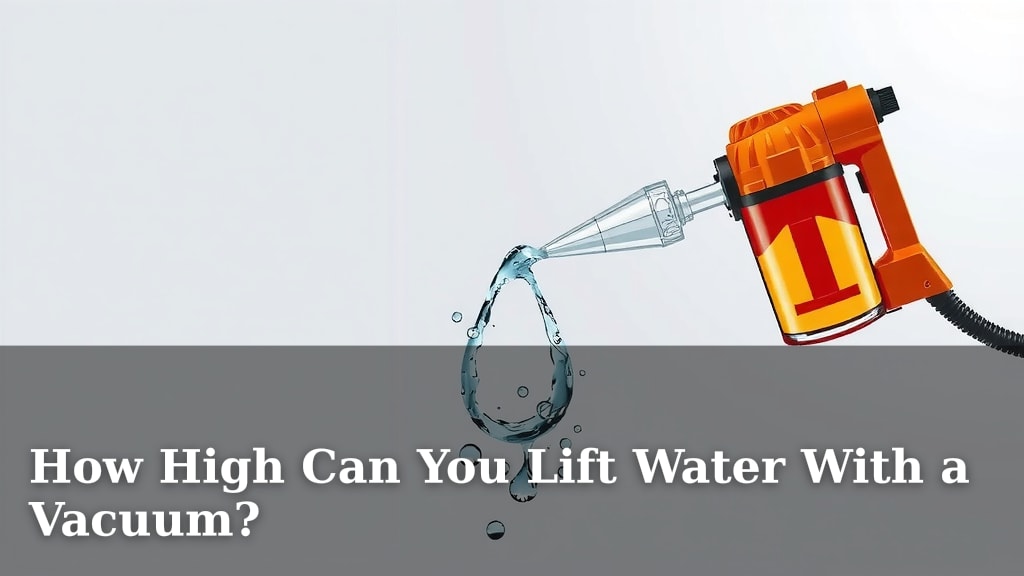
How High Can You Lift Water With a Vacuum?
No, you can’t lift water with a perfect vacuum beyond a certain height. In reality, atmospheric pressure is the real hero holding water up. A perfect vacuum can only support a column of water about 33.9 feet (10.3 meters) tall at sea level. Any higher, and gravity wins.
Think of it like this: air all around us exerts pressure. This pressure is what pushes water up into a vacuum, essentially balancing the weight of the water column. When that water column gets too heavy, the atmospheric pressure just isn’t enough to hold it up anymore. So, while we talk about vacuums, it’s really the air pressure we’re working with.
- A perfect vacuum can lift water about 33.9 feet.
- Atmospheric pressure is the force actually holding water up.
- Gravity pulls the water down, limiting how high it can go.
- Real-world conditions can affect this height.
Let’s dive a little deeper into why this happens and what factors play a role. It’s a bit of a mind-bender, but we’ll break it down simply.
Lifting Water with Air Pressure: Understanding the Limits
So, you’re curious about how high you can actually lift water using a vacuum. It’s a fascinating question that often leads to a bit of a surprise! The short answer is that a perfect vacuum won’t lift water indefinitely. Instead, it’s the air around us that’s doing the heavy lifting, and it has its limits.
Think of it like a see-saw. On one side, you have the weight of the water you’re trying to lift. On the other side, you have the pressure of the air pushing down on the water’s surface. When these two forces are balanced, the water stays put. But if the water column gets too tall, its weight can overcome the air pressure, and down it comes.
The Science Behind the Lift
This whole process is a beautiful demonstration of atmospheric pressure. We don’t really notice it because we’re used to it, but the air surrounding our planet exerts a constant force. This force is what allows for simple devices like drinking straws and some types of pumps to work.
What is Atmospheric Pressure?
Atmospheric pressure is simply the weight of the air in the Earth’s atmosphere pressing down on everything. At sea level, this pressure is about 14.7 pounds per square inch (psi). That might not sound like much, but when you multiply it by the surface area of objects, it adds up to a substantial force.
How Does it Lift Water?
When you create a vacuum, you’re removing the air pressure from one side of the system. Imagine a sealed tube filled with water, with the top end sealed and the bottom end submerged in a larger body of water. If you could magically remove all the air from inside the tube, the atmospheric pressure pushing down on the water outside the tube would push the water *up* into the tube.
This upward push continues until the weight of the water column inside the tube equals the downward pressure from the atmosphere. This balance point is the maximum height you can achieve. It’s like trying to push a balloon underwater; the water pushes back.
The 33.9-Foot Barrier
At sea level, under standard conditions, the maximum height a perfect vacuum can support a column of water is approximately 33.9 feet (or about 10.3 meters). This isn’t because the vacuum itself has a lifting capacity; it’s because that’s the height at which the weight of the water column perfectly counteracts the force of atmospheric pressure.
Any attempt to lift the water higher means the water column would weigh more than the atmospheric pressure can support. Gravity would then win, and the water would spill back down, leaving a partial vacuum at the top. This is why you can’t just make a super-tall straw and expect it to work perfectly beyond this limit.
Gravity’s Unwavering Pull
Gravity is always working against us when we try to lift things, including water. It’s the fundamental force pulling everything towards the center of the Earth. The taller the column of water, the greater its weight, and the stronger gravity’s pull becomes on that mass.
The Role of the Vacuum
It’s important to remember that the vacuum isn’t “sucking” the water up. Instead, the absence of air pressure in the vacuum allows the existing atmospheric pressure to push the water into that space. If you’ve ever used a simple water pump, like one on a well, you’ve seen this principle in action. The pump creates a partial vacuum, and atmospheric pressure pushes the water up into it.
Factors Affecting Water Lifting Height
While 33.9 feet is the theoretical limit at sea level, several real-world factors can alter this height. You won’t always achieve this exact measurement in practice.
Altitude: A Higher Starting Point
As you go higher in altitude, the atmospheric pressure decreases. This means there’s less force pushing down on the water. Consequently, the maximum height you can lift water with a vacuum also decreases. For instance, in Denver, Colorado, which is about a mile high, the atmospheric pressure is lower, so the maximum lift height would be significantly less than 33.9 feet.
We found that for every 1,000 feet of elevation gain, you lose about 1 foot of lifting capacity. So, at 5,000 feet, you might only be able to lift water about 29 feet!
Temperature: A Surprising Influence
Water temperature can also play a small role. Warmer water is less dense than colder water. Since pressure is related to the weight of the liquid column, a less dense column of warm water would weigh slightly less than a column of cold water of the same height. However, this effect is minor compared to altitude.
More significantly, if the water gets too warm inside the vacuum space, it can start to evaporate. This evaporation can create vapor pressure, which effectively counteracts some of the vacuum. This is why pumps often have cooling mechanisms to prevent overheating.
Imperfect Vacuums in Reality
Achieving a truly “perfect” vacuum is incredibly difficult, if not impossible, outside of highly controlled laboratory conditions. In any real-world scenario, there will always be some residual air or vapor. This imperfect vacuum means the pressure difference isn’t as great, further reducing the maximum lifting height.
Think about trying to suck liquid through a straw that has a tiny leak. You won’t be able to lift the liquid as high because air is getting in, reducing the vacuum effect. Many experts say that practical pumps often achieve about 80-90% of the theoretical vacuum lift.
Common Misconceptions About Vacuums and Water
One of the most common misunderstandings is that a vacuum “sucks.” This is a handy way to think about it, but it’s not scientifically accurate. A vacuum is an absence of pressure. It’s the higher pressure outside the vacuum that *pushes* things into it.
Imagine you’re in a room with no air (a vacuum). If you open a door to a room full of air, the air rushes in because the higher pressure is pushing it. It’s not that the empty room is “pulling” the air.
When Does a Vacuum Help Move Water?
Even with these limitations, understanding vacuum principles is essential for many technologies. Water pumps, whether in your home, a car’s engine, or industrial settings, rely on creating partial vacuums to move water efficiently.
| Scenario | Theoretical Max Lift (at Sea Level) | Practical Max Lift (Estimated) |
|---|---|---|
| Perfect Vacuum | 33.9 feet (10.3 meters) | N/A (idealized) |
| Real-World Pump (Good Conditions) | N/A | ~25-28 feet (7.6-8.5 meters) |
| Real-World Pump (High Altitude) | N/A | < 25 feet (dependent on altitude) |
This table shows that while the theoretical limit is a good benchmark, practical applications often fall short due to real-world conditions.
A Quick Checklist for Understanding Vacuum Lift
- Remember it’s air pressure, not the vacuum itself, doing the lifting.
- Know the 33.9-foot limit at sea level for a perfect vacuum.
- Consider how altitude significantly reduces this limit.
- Understand that imperfect vacuums are the norm in reality.
- Don’t think of vacuums as “sucking” – think of pressure pushing.
- Appreciate how these principles power everyday water pumps.
Conclusion
So, you’ve learned that lifting water with a vacuum isn’t really about the vacuum itself. It’s the powerful push of atmospheric pressure that does the work, and it has a limit. At sea level, you can expect about 33.9 feet of lift in perfect conditions, but real-world factors like altitude and imperfect vacuums reduce that height. Remember, it’s pressure pushing, not a vacuum pulling. Now that you understand the science, you can better appreciate how simple pumps work and why they have their own height restrictions. For your next project involving moving water, always factor in these real-world limitations and the incredible force of the air around you.
Frequently Asked Questions
What’s the absolute maximum height water can be lifted with a vacuum?
The theoretical maximum height you can lift water with a perfect vacuum at sea level is approximately 33.9 feet (10.3 meters). This height is determined by the point where the weight of the water column equals the force of atmospheric pressure pushing it up.
Does altitude really affect how high water can be lifted?
Yes, absolutely! As you increase in altitude, atmospheric pressure decreases. This means there’s less pressure pushing the water up, so the maximum lifting height is reduced. Research suggests you lose about 1 foot of lift capacity for every 1,000 feet in elevation gain.
Can a real-world pump achieve the full 33.9 feet lift?
Generally, no. Achieving a perfect vacuum is nearly impossible in practical applications. Real-world pumps often create partial vacuums, and factors like residual air or vapor further reduce the lifting capacity. You can typically expect practical pumps to lift water around 25 to 28 feet at sea level.
Is it the vacuum “sucking” the water up?
That’s a common misconception! A vacuum is actually an absence of pressure. It’s the higher atmospheric pressure on the surface of the water that *pushes* the water into the low-pressure area created by the vacuum. Think of it as air pressure doing the heavy lifting.
What happens if you try to lift water higher than the limit?
If you try to lift water beyond the height that atmospheric pressure can support, gravity will win. The excess weight of the water column will cause it to fall back down, and you’ll end up with a partial vacuum at the top instead of a full column of water.


![7 Best Electric Vacuum Pump For Brakes [2026]](https://bathroomexplorer.com/wp-content/uploads/2026/05/7-best-electric-vacuum-pump-for-brakes-2026-featured-768x432.jpg)