
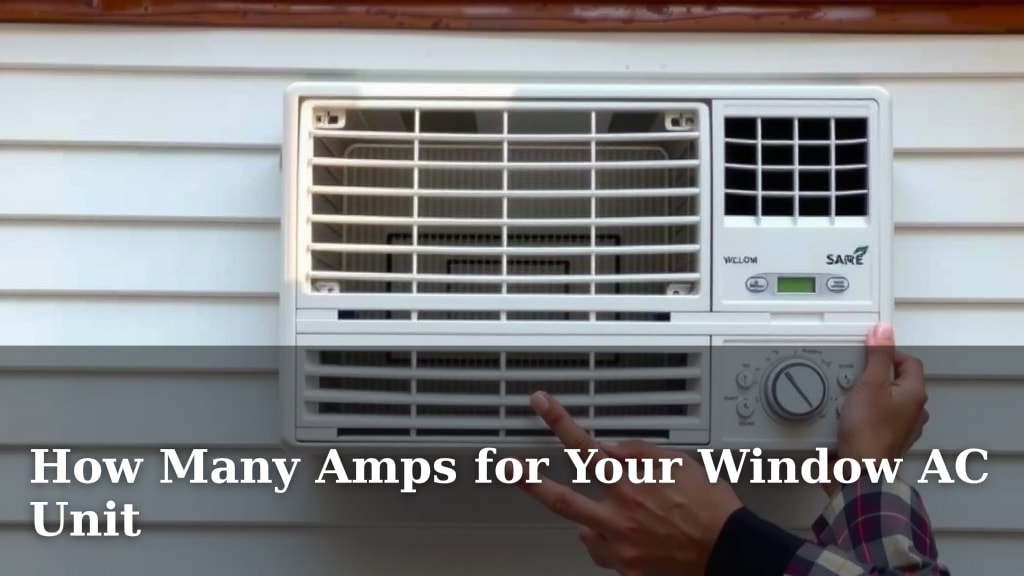
How Many Amps for Your Window AC Unit
Choosing the right amperage for your window air conditioner is key to ensuring it runs efficiently and safely. Most standard window AC units typically require a 15-amp circuit, but larger or more powerful models might need a 20-amp circuit. Always check the unit’s label or your home’s electrical panel to be sure.
Understanding your home’s electrical capacity is more than just an AC concern; it’s about preventing annoying breaker trips. Using the correct amperage prevents overheating and ensures your new cool-air friend doesn’t cause more heat in your electrical system. We found that many people overlook this detail, leading to minor electrical headaches.
- Most window ACs need a 15-amp circuit.
- Bigger units might need a 20-amp circuit.
- Check the unit’s label or your breaker box.
- Using the right amperage prevents trips and protects your system.
We’ve gathered the details to help you figure out exactly how many amps your window air conditioner needs. Let’s walk through what you need to know to keep your home cool and your circuits happy.
Understanding Your Window AC’s Power Needs
Deciding on the right amperage for your window air conditioner is super important. It ensures your unit runs smoothly and stays safe. You don’t want any surprises when you’re just trying to beat the heat!
Most typical window AC units work just fine on a 15-amp circuit. Think of it like the standard lane on a highway; it handles most of the everyday traffic. But what if you have a larger room, or you’re eyeing a really powerful AC unit? Then you might need to think about a 20-amp circuit.
This isn’t just about avoiding a tripped breaker. Using the correct amperage helps prevent overheating. It makes sure your new cool-air friend doesn’t cause more heat in your home’s electrical system. We found that many people overlook this detail, leading to minor electrical headaches. Let’s get you squared away.
How to Find the Right Amperage for Your AC
So, how do you actually figure this out? It’s simpler than you might think. You just need to know where to look. The unit itself and your home’s electrical panel are your best friends here.
Check the Air Conditioner’s Label
Your window air conditioner comes with a label, usually on the side or back. This label is like its own little instruction manual. It will clearly state the electrical requirements. Look for information on voltage (like 115V or 120V) and the amperage (amps).
You’ll often see a number followed by “A” for amps. This tells you the maximum current the unit draws. It might say something like “12.5 A” or “14.8 A”. This is the most direct way to know what your specific AC needs.
Consult Your Home’s Electrical Panel
Your electrical panel, or breaker box, is the control center for your home’s electricity. It has different breakers for different circuits. Each breaker is rated for a certain amperage, typically 15 amps or 20 amps. This is the maximum load that circuit can handle.
If your AC unit is designed for a standard outlet (the kind you plug most appliances into), it’s likely on a 15-amp circuit. If it requires a different type of outlet, or if it’s a particularly large unit, it might need a dedicated 20-amp circuit. We found that sometimes, larger AC units are pre-wired for a 20-amp plug.
Understanding Different Outlet Types
You might notice that some AC units have plugs that look different. This is a clue! A standard plug usually fits into a 15-amp outlet. If your AC has a plug that looks wider or has a different shape, it might be for a 20-amp circuit.
Many experts say that plugging an appliance into an outlet that is on a circuit with lower amperage than the appliance requires is a recipe for tripped breakers. It’s like trying to fit a giant puzzle piece into a tiny hole – it just won’t work.
Amperage vs. Wattage: What’s the Difference?
Sometimes, you’ll see wattage (W) mentioned instead of amperage. Wattage tells you the total power a unit uses. Amperage tells you how much electrical current is flowing. They are related!
The basic formula is: Watts = Volts x Amps. So, if you know two of these numbers, you can calculate the third. For example, a 1200-watt air conditioner on a 120-volt circuit draws 10 amps (1200W / 120V = 10A).
Knowing the amperage is key for circuit safety. It tells you if the circuit can handle the electrical flow without overheating. Think of amperage like the width of a pipe; if too much water tries to flow through a narrow pipe, you have a problem.
Why Correct Amperage is Crucial
Using the correct amperage for your window air conditioner isn’t just a suggestion; it’s a safety and performance necessity. Let’s break down why it matters so much.
Preventing Overheating and Fires
The electrical wiring in your home is designed to handle a certain amount of current. When an appliance draws more amperage than the circuit can safely provide, the wires can overheat. This is a serious fire hazard. Using an AC unit on an overloaded circuit is something many fire safety organizations strongly warn against.
The circuit breaker is there to protect you. It’s designed to trip (shut off power) before the wires get dangerously hot. But you don’t want to rely on it constantly. It’s better to match the AC’s needs to the circuit’s capacity from the start.
Avoiding Annoying Breaker Trips
Does the thought of your air conditioner shutting off unexpectedly make you sigh? We get it! Tripped breakers are incredibly annoying, especially on a hot day. This often happens when you run too many appliances on the same circuit, or if your AC is too powerful for the circuit it’s plugged into.
A dedicated circuit for your air conditioner is often the best solution for larger units. This means the circuit is exclusively for the AC, so it doesn’t have to compete with other high-draw appliances like microwaves or toasters. We found that this simple setup can drastically reduce breaker trips.
Ensuring Efficient Operation
When your air conditioner receives the proper amount of power, it runs more efficiently. It can reach your desired temperature faster and maintain it without struggling. This can even lead to energy savings over time.
An undersized circuit or an overloaded one can make your AC work harder than it needs to. It might cycle on and off more frequently or struggle to cool your room effectively. You want your AC to be the star of the show, not be bogged down by power limitations.
When to Consider a 20-Amp Circuit
While many window AC units are happy with a 15-amp circuit, there are definite times when a 20-amp circuit becomes the smarter choice. This usually comes down to the size and power of the air conditioner.
Larger Capacity Units
Air conditioners are rated in BTUs (British Thermal Units), which measure their cooling power. Units with higher BTU ratings (like those for larger rooms or open-concept areas) generally consume more electricity. They require more amps to do their job.
For example, a 10,000 BTU or 12,000 BTU unit might push the limits of a standard 15-amp circuit, especially if other devices share that circuit. A unit rated for 15,000 BTUs or more almost always needs a 20-amp circuit. We found that checking the label is your best bet.
Units with Specific Plug Types
As mentioned earlier, the plug itself can be a giveaway. If your AC unit has a plug that doesn’t look like your typical three-prong plug, it’s probably designed for a 20-amp outlet. These outlets sometimes have one slot that is horizontal, or the prongs are arranged in a specific pattern.
If you see one of these specialized plugs, do not try to force it into a standard outlet. It won’t fit, and even if it did, it would be unsafe. Your home’s wiring needs to match the appliance’s requirements.
Quick Checklist for Your AC’s Power Needs
Before you plug in that new window AC, take a moment to check these things. It’s a quick way to ensure everything is set up correctly and safely:
- Find the AC unit’s label. Look for the “Amps” rating.
- Note the plug type. Does it look standard or specialized?
- Check your electrical panel. See the breaker ratings (15A or 20A).
- Identify the circuit. Is the AC on a dedicated circuit or sharing?
- Match the AC to the circuit. Ensure the circuit amperage meets or exceeds the AC’s needs.
- Consider professional help. If unsure, an electrician can confirm your circuit capacity.
Conclusion
You’ve learned that most window ACs run on a 15-amp circuit, but larger or high-BTU models might need a 20-amp circuit. Always check your unit’s label and your home’s electrical panel to confirm the exact requirements. Matching your AC’s amperage needs to the right circuit is key to preventing overheating, avoiding tripped breakers, and ensuring your unit cools your home efficiently. Don’t guess; verify!
Before plugging in your new air conditioner, take a moment to look at its label and your breaker box. If you’re unsure about your home’s electrical capacity or how to identify the correct circuit, it’s always best to consult a qualified electrician. They can ensure your setup is safe and ready to keep you cool all summer long.
Frequently Asked Questions
What happens if I plug a 20-amp AC into a 15-amp outlet?
Plugging a 20-amp air conditioner into a standard 15-amp outlet is generally not possible because the plugs are different. If you were to somehow bypass this safety feature, it would very likely trip the 15-amp breaker immediately. This is a safety mechanism to prevent overloading the circuit.
Can I run a window AC on the same circuit as my TV or computer?
It’s often best to avoid running a window AC on the same circuit as other high-draw appliances like TVs, computers, or microwaves if possible. We found that sharing circuits, especially 15-amp ones, can easily lead to tripped breakers. For consistent cooling, a dedicated circuit is ideal for larger AC units.
How do I know if my outlet is 15-amp or 20-amp?
You can usually tell by looking at the outlet’s configuration. Standard 15-amp outlets typically have two parallel vertical slots and a U-shaped ground hole. A 20-amp outlet will often have one of the vertical slots appearing as a “T” shape, indicating it can accept different plug types.
Does the BTU rating of an air conditioner relate to its amperage needs?
Yes, higher BTU ratings generally mean more powerful cooling and thus higher amperage requirements. A small 5,000 BTU unit might only need around 5-6 amps, while a 12,000 BTU unit could draw 10-12 amps or more. Always check the unit’s label for precise amperage information.
Is it safe to use an extension cord with a window air conditioner?
We strongly advise against using extension cords with window air conditioners, especially for units requiring 15 or 20 amps. Extension cords can overheat, pose a fire risk, and may not be rated to handle the sustained high current draw of an AC unit. It’s best to plug the AC directly into a properly rated wall outlet.

![7 Best Inverter Split Air Conditioner [2026]](https://bathroomexplorer.com/wp-content/uploads/2026/06/7-best-inverter-split-air-conditioner-2026-featured-768x432.jpg)
![7 Best Delonghi Air Conditioner [2026]](https://bathroomexplorer.com/wp-content/uploads/2026/06/7-best-delonghi-air-conditioner-2026-featured-768x432.jpg)