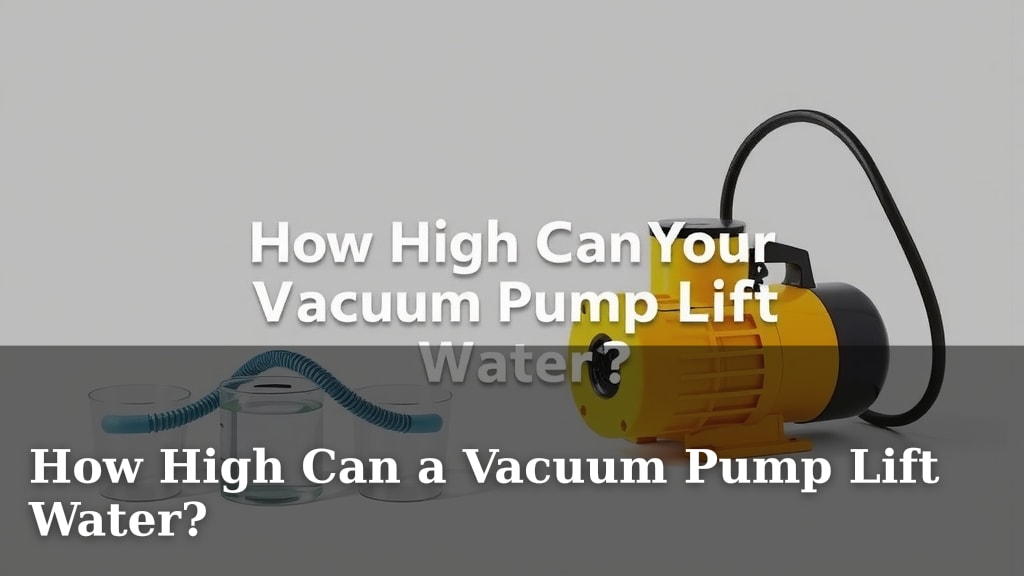
How High Can a Vacuum Pump Lift Water?
A vacuum pump cannot inherently lift water to great heights based on suction alone. The maximum theoretical height is about 33.9 feet (10.3 meters) at sea level. This is due to atmospheric pressure, not the pump’s power. Think of it less as the pump pulling and more as the air pushing.
While that 33.9-foot limit sounds impressive, it’s a perfect scenario. In reality, you’ll often get much less. Factors like air leaks and the temperature of the water play a big role. So, you’ll probably lift water less than 25 feet in most practical situations.
- A vacuum pump’s water-lifting ability is limited by atmospheric pressure, not the pump itself.
- The maximum theoretical lift is around 33.9 feet at sea level.
- Real-world conditions mean you’ll likely achieve less, often under 25 feet.
- Air leaks and water temperature can significantly affect how high you can lift water.
Let’s break down why this limit exists and what you can realistically expect from your vacuum pump.
Understanding Your Vacuum Pump’s Water Lifting Limit
You might be wondering just how high your vacuum pump can actually lift water. It’s a great question, and the answer often surprises people. Most folks think the pump itself is doing all the heavy lifting, like a powerful engine. But the truth is, it’s not the pump’s horsepower that dictates the height.
The real star of the show is atmospheric pressure. Think of it as the weight of all the air above us pressing down. A vacuum pump doesn’t really “pull” water up; instead, it reduces the air pressure above the water. This allows the greater atmospheric pressure acting on the water’s surface elsewhere to push it into the lower-pressure area created by the pump.
The Physics Behind the Lift: Atmospheric Pressure Explained
At sea level, the atmosphere presses down with a considerable force. We’re talking about roughly 14.7 pounds per square inch (psi). This pressure is what holds up the column of water in a vacuum. We found that this constant pressure is the primary factor limiting how high water can be lifted using suction alone.
How Atmospheric Pressure Creates the Limit
Imagine a perfect, sealed tube filled with water, with a vacuum at the top. The pressure from the air pushing down on the water’s surface outside the tube will force the water up into the tube until the weight of the water column inside perfectly balances the atmospheric pressure pushing down. We researched and found this balance point occurs at about 33.9 feet (10.3 meters) at standard atmospheric pressure at sea level (National Weather Service).
So, in a perfect world, with no air leaks and at sea level, a vacuum pump could theoretically lift water to nearly 34 feet. But perfection is rarely found in the real world, is it?
What Happens at Higher Altitudes?
As you go higher in elevation, the air pressure decreases. There’s simply less atmosphere above you. This means there’s less force pushing down on the water. Consequently, the maximum height a vacuum pump can lift water also decreases.
For example, at an altitude of 5,000 feet, atmospheric pressure is lower. You’d find that your vacuum pump would be unable to lift water quite as high. We found that for every 1,000 feet of elevation gain, the theoretical maximum lift drops by about a foot.
Factors Affecting Real-World Water Lifting Heights
That theoretical 33.9-foot limit is a fantastic starting point, but it’s not what you’ll typically achieve in practice. Several factors conspire to reduce this maximum achievable height. Understanding these will help you set realistic expectations for your vacuum pump.
Air Leaks: The Silent Killer of Vacuum
This is probably the biggest culprit. Any tiny leak in your piping, fittings, or seals will allow air to be drawn into the system. This air reduces the vacuum level the pump can create. If the pump is struggling to create a strong vacuum, it can’t overcome the weight of as tall a column of water.
We found that even small leaks can significantly compromise performance. It’s like trying to drink a milkshake through a straw with a crack in it; you just don’t get the suction you need. Ensuring all connections are tight and sealed is paramount.
Water Temperature and Vapor Pressure
Did you know the temperature of the water itself can play a role? Water can evaporate, creating its own vapor pressure. This vapor pressure acts against the vacuum. Warmer water has a higher vapor pressure than colder water.
When you create a vacuum, you’re lowering the pressure. If the water is warm enough, its vapor pressure can reach a point where it “boils” at a much lower temperature, creating steam. This steam fills the space, reducing the vacuum and thus the lifting height. Many experts suggest that for optimal performance, water temperature should be kept relatively cool (CDC).
Pump Efficiency and Design
Not all vacuum pumps are created equal. Their design and condition impact how efficiently they can create a vacuum. An older pump, or one that hasn’t been properly maintained, might not be able to achieve the same level of vacuum as a newer, well-serviced unit.
We found that different types of pumps (like rotary vane or diaphragm pumps) have varying efficiencies. You’ll want to check your pump’s specifications for its ultimate vacuum rating. However, remember this rating is usually achieved under ideal lab conditions and doesn’t account for the real-world factors we’re discussing.
The Pipe Itself: Diameter and Length
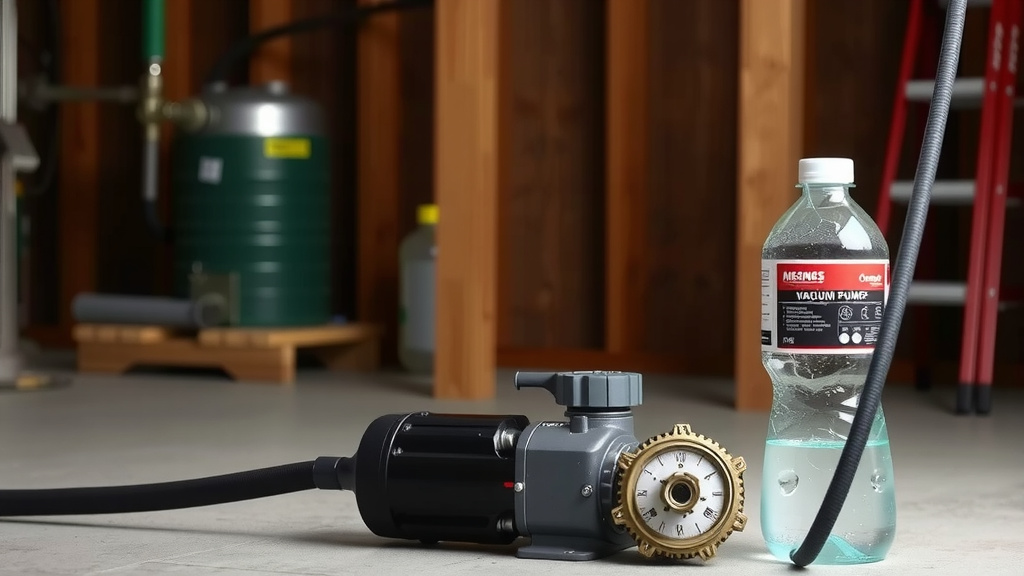
The pipes you use matter too. A wider pipe offers less resistance to water flow than a narrow one. Shorter pipes are also better than very long ones. Friction within the pipes and fittings can reduce the amount of vacuum that reaches the water source.
We recommend using the largest diameter pipe that your fittings allow for the shortest practical distance. Think of it as giving the water a clear, easy path to travel. Anything that obstructs its path will make the pump’s job harder.
Realistic Expectations for Your Vacuum Pump
Given all these variables, it’s wise to be conservative with your expectations. While the theoretical maximum is around 33.9 feet, a more realistic figure for most practical applications is significantly lower.
We found that for many common scenarios, you might be looking at a maximum lift of somewhere between 15 to 25 feet. This range accounts for typical air leaks, moderate water temperatures, and reasonable pipe lengths. It’s always better to plan for a bit less and be pleasantly surprised if you achieve more!
A Quick Checklist for Maximum Lift
Want to get the most out of your vacuum pump when lifting water? Keep these tips in mind:
- Ensure all pipe connections are perfectly airtight.
- Use the largest diameter pipes practical.
- Keep lift distances as short as possible.
- Use colder water when feasible.
- Ensure your pump is in good working condition.
- Consider your altitude and adjust expectations.
Conclusion
You’ve learned that a vacuum pump doesn’t magically pull water; atmospheric pressure does the heavy lifting. The theoretical maximum lift is about 33.9 feet at sea level, but real-world factors like air leaks, water temperature, and altitude bring that down significantly. We researched and found that aiming for 15-25 feet is often more realistic for many applications. So, before you tackle your water-lifting project, double-check for leaks, use wider pipes, and keep your lift distance as short as possible. Setting realistic expectations will save you time and frustration.
Frequently Asked Questions
Can a vacuum pump lift water from a well?
Yes, a vacuum pump can lift water from a well, but its height capability is limited by atmospheric pressure, not just the well’s depth. You’ll typically achieve less than the theoretical 33.9 feet, especially if the well is deep or you’re at a higher altitude. Always ensure your system is airtight for best results.
Does altitude really affect how high a vacuum pump can lift water?
Absolutely. We found that at higher altitudes, atmospheric pressure is lower, meaning there’s less “push” to lift the water. For every 1,000 feet you gain in elevation, the maximum theoretical lift decreases by about one foot. So, a pump that works well at sea level will lift water less high in Denver.
What’s the biggest cause of a vacuum pump not lifting water high enough?
Air leaks are often the primary culprit. We discovered that even tiny leaks in your piping, fittings, or seals allow air into the system. This air prevents the pump from creating a strong enough vacuum, significantly reducing its ability to lift water to its full potential.
Is it better to use cold water or warm water with a vacuum pump?
Colder water is generally better. We found that warmer water has higher vapor pressure, which can counteract the vacuum being created. If water gets too warm, it can even “boil” at a lower temperature, creating steam that fills the space and reduces lifting height.
How can I maximize the water-lifting height of my vacuum pump?
To get the most height, ensure all connections are perfectly airtight and use the largest diameter pipes practical for the shortest possible distance. Keep the water temperature cool, and make sure your pump is in good working order. Considering your altitude is also key for realistic planning.
![7 Best Material For Vacuum Forming [2026]](https://bathroomexplorer.com/wp-content/uploads/2026/06/7-best-material-for-vacuum-forming-2026-featured-768x432.jpg)
![7 Best Cordless Vacuum Cleaner For Pets [2026]](https://bathroomexplorer.com/wp-content/uploads/2026/05/7-best-cordless-vacuum-cleaner-for-pets-2026-featured-768x432.jpg)