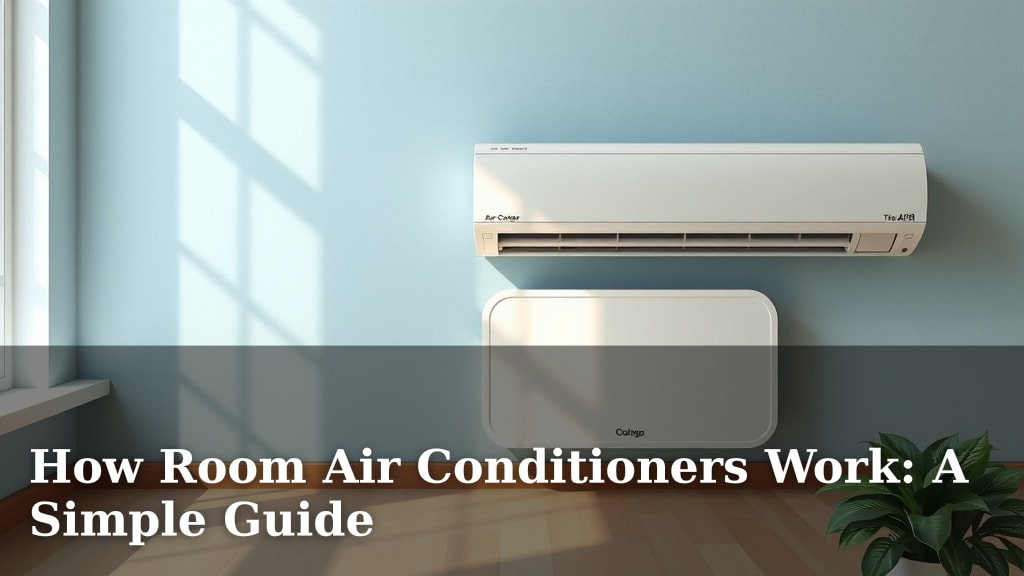
How Room Air Conditioners Work: A Simple Guide
Room air conditioners work by using a special fluid called refrigerant to move heat from inside your home to the outdoors. They essentially act like a heat pump, but are designed specifically for cooling. This process involves a cycle of compressing, condensing, expanding, and evaporating the refrigerant to absorb and release heat. You’ll feel the difference as your room gets cooler.
Think of it like your refrigerator, but on a bigger scale. An AC unit has both an indoor coil and an outdoor coil. The indoor coil absorbs heat from the air in your room, while the outdoor coil releases that heat back outside. A fan circulates the air, making your space much more comfortable on hot days.
- Room air conditioners use refrigerant to move heat.
- They have indoor and outdoor coils to absorb and release heat.
- A fan helps circulate cooler air into your room.
- This process cools your home effectively and efficiently.
Let’s walk through exactly how this cooling magic happens, step by step.
Understanding How Your Room Air Conditioner Cools
Ever wonder what magic happens inside your window AC unit to turn a stuffy room into a cool oasis? It’s all about a clever process of moving heat. Your air conditioner doesn’t actually create cold air. Instead, it acts like a heat sponge, soaking up the warmth from your room and dumping it outside.
The Heart of the Matter: Refrigerant
The star player in this cooling show is a special fluid called **refrigerant**. This substance is pretty amazing. It can easily change between a liquid and a gas. This ability is key to its job of absorbing and releasing heat. You might know it by names like Freon or R-410A. It circulates through the AC system in a closed loop.
Phase Changes: Liquid to Gas and Back
Refrigerant’s magic relies on its **phase changes**. When it absorbs heat, it turns from a liquid into a gas. This process requires energy, and it pulls that energy (heat) from your room air. Later, when it releases heat, it changes back from a gas into a liquid. This cycle is what cools your space.
The Two Coils: Where the Action Happens
Your air conditioner has two main sets of coils. Think of them as the AC’s hands. One set lives inside your room, and the other lives outside. They are connected by copper tubing that carries the refrigerant.
The Evaporator Coil (Indoor Coil)
This coil is located behind the front panel of your AC unit, the part you see inside your room. As warm room air is pulled into the AC by a fan, it passes over the cold evaporator coil. The refrigerant inside this coil is currently in a low-pressure, cold liquid state. It’s so cold, in fact, that it easily absorbs heat from the air blowing across it. As the refrigerant absorbs heat, it starts to **evaporate**, turning into a gas. This leaves the air that’s blown back into your room much cooler. You can often see frost on these coils if your AC is very cold and the humidity is high.
The Condenser Coil (Outdoor Coil)
Once the refrigerant has done its job absorbing heat, it’s now a warm gas. This warm gas travels through the copper tubing to the outdoor unit. Here, it flows through the condenser coil. This coil is exposed to the outside air. Another fan, located in the outdoor section of the unit, blows outside air across the condenser coil. This airflow helps to cool the refrigerant. As the refrigerant cools, it **condenses** back into a liquid. This is where the heat absorbed from your room is released into the outdoor air. It’s like the AC is exhaling warm air. This process is crucial for the system to work efficiently.
The Compressor: The System’s Engine
Sitting in the outdoor part of your AC unit is the compressor. This is arguably the most important component. Its job is to **compress** the refrigerant gas. When you compress a gas, you increase its pressure and its temperature. Think of pumping up a bike tire – the pump gets warm. The compressor takes the cool, low-pressure refrigerant gas from the evaporator coil and squeezes it into a hot, high-pressure gas. This hot, high-pressure gas then moves to the condenser coil to release its heat.
The compressor also helps move the refrigerant through the system. Without it, the refrigerant would just sit there. It’s the powerful engine driving the entire cooling cycle. Many experts point out that the compressor uses the most electricity in an AC unit (U.S. Department of Energy).
The Expansion Valve: Preparing for the Next Cycle
After the refrigerant leaves the condenser coil as a high-pressure liquid, it needs to be prepared to absorb more heat. It flows through a tiny device called an expansion valve (or capillary tube). This valve acts as a restriction. As the high-pressure liquid refrigerant passes through the narrow opening of the expansion valve, its pressure drops dramatically. This sudden drop in pressure causes the refrigerant to become very cold and partially vaporize. It’s now ready to head back to the evaporator coil to start the heat absorption process all over again. This constant cycle is what keeps your room cool.
The Fans: Circulating Air
You can’t have cool air without moving it. Your air conditioner uses two fans. One fan, typically in the front of the unit, pulls warm room air into the AC. It then pushes the newly cooled air back out into your room. The other fan is usually in the outdoor section. It blows outside air across the condenser coils to help release the heat effectively. Good airflow is essential for efficient cooling, and many studies show that keeping vents clear and filters clean can improve performance.
Putting It All Together: A Simple Analogy
Imagine you have a sponge that loves water. Your room is humid and warm. You take the sponge outside and squeeze all the water out, making it thirsty for more. That’s like the compressor heating up the refrigerant. Then, you bring the dry sponge inside and soak up all the moisture from your room air. That’s the evaporator coil absorbing heat. Once the sponge is soaked, you take it back outside and squeeze the water out again, releasing the moisture into the air. This continuous cycle is how your AC keeps you comfortable.
The Refrigeration Cycle in Steps
Let’s recap the journey of the refrigerant:
- Evaporation (Indoor Coil): Refrigerant absorbs heat from room air, turning from a cold liquid into a cool gas.
- Compression: The compressor squeezes the cool gas, turning it into a hot, high-pressure gas.
- Condensation (Outdoor Coil): The hot gas releases its heat to the outside air, turning back into a warm liquid.
- Expansion: The expansion valve reduces the pressure of the warm liquid, making it very cold and ready to absorb heat again.
Maintaining Your Cool: Simple Checks
Keeping your room air conditioner running smoothly doesn’t have to be complicated. Here are a few simple things you can do:
- Clean or replace the air filter monthly. A dirty filter restricts airflow, making your AC work harder.
- Keep the outdoor unit clear of debris. Ensure leaves, grass, or other obstructions aren’t blocking the condenser coils.
- Check that the unit is level. If it’s a window unit, make sure it’s securely installed and slightly tilted outwards to allow drainage.
- Listen for unusual noises. Grinding or rattling sounds can indicate a problem that needs professional attention.
- Inspect the drain hose or pan. Make sure water can drain freely to prevent clogs and potential water damage.
Conclusion
You’ve now seen how your room air conditioner masterfully moves heat from your living space to the great outdoors. It’s a continuous cycle involving refrigerant’s fascinating changes between liquid and gas. The compressor, coils, and fans all work together in a symphony of science. Keeping your AC clean and clear helps this system run smoothly. By understanding this process, you can better appreciate your cool comfort and know how to keep it going. Take a moment to check your air filter this week—it’s a simple step that makes a big difference!
Frequently Asked Questions
How does a room air conditioner make the air feel drier?
As your AC cools the air, it also removes moisture. Warm air can hold more moisture than cool air. When the warm, humid air from your room passes over the cold evaporator coils, the moisture in the air condenses into water. This water then drips away, which is why you see water draining from an AC unit.
What is the role of the compressor in an AC unit?
The compressor is like the heart of your air conditioner. It pumps the refrigerant through the system and increases its pressure and temperature. This high-pressure, hot gas is then ready to release its heat to the outside air. Without the compressor, the refrigerant wouldn’t circulate or get hot enough to effectively transfer heat.
Can I use my AC if the outdoor unit is covered in dirt or leaves?
It’s not recommended. The outdoor unit, specifically the condenser coils, needs good airflow to release heat efficiently. When these coils are blocked by dirt or leaves, your AC has to work much harder, reducing its cooling capacity and potentially causing damage. Clearing away obstructions will help your unit perform better.
Why does my AC sometimes make strange noises?
Noises can indicate a few things. A rattling sound might mean a loose part or debris. A grinding noise often points to an issue with the compressor or fan motor. Hissing sounds could indicate a refrigerant leak. If you hear any unusual noises that persist, it’s best to have a technician check your unit.
Is it normal for the indoor coil to sometimes look frosty?
Seeing a light frost on the indoor evaporator coil can happen, especially in very humid conditions. However, if the frost becomes thick ice, it’s a sign of a problem. This usually means airflow is restricted, perhaps by a dirty filter, or there’s an issue with the refrigerant level. Heavy icing prevents efficient cooling.
![7 Best Central Air Conditioner Manufacturers [2026]](https://bathroomexplorer.com/wp-content/uploads/2026/06/7-best-central-air-conditioner-manufacturers-2026-featured-768x432.jpg)
![7 Best Small Split System Air Conditioner [2026]](https://bathroomexplorer.com/wp-content/uploads/2026/06/7-best-small-split-system-air-conditioner-2026-featured-768x432.jpg)