How Many Fans Equal One Air Conditioner?
So, you’re wondering how many fans equal an air conditioner for cooling your space? The short answer is: it’s complicated, and fans don’t actually lower the air temperature like an AC does. While a few powerful fans can make a room *feel* cooler by moving air, they can’t replace the temperature-dropping capabilities of an air conditioner for true climate control, especially on very hot days.
Think of it this way: fans create a wind chill effect on your skin, making you feel more comfortable. An air conditioner, on the other hand, actually removes heat and humidity from the air, lowering the room’s overall temperature. We found that while fans are great for air circulation and personal comfort, they don’t have the same cooling power as a dedicated AC unit.
- Fans create a “wind chill” effect on your skin.
- They don’t lower the actual air temperature like an AC.
- An AC removes heat and humidity from the air.
- Fans are best for air circulation and mild comfort.
- For true cooling, an AC is needed, especially in heat.
Let’s break down the differences and see when a fan might be enough, and when you’ll really want that air conditioner.
Fans vs. Air Conditioners: How They Actually Cool You
Let’s get straight to the heart of it: how many fans does it take to equal an air conditioner? The honest answer is that you can’t truly equate them. While fans are fantastic for making you feel cooler, they work on a completely different principle than an AC. Think of it like comparing a misting spray bottle to a refrigerated drink – one offers a momentary refreshing sensation, while the other actually lowers the temperature of what you’re consuming.
The Science Behind Feeling Cooler
Your body temperature is typically around 98.6°F. When the air temperature rises, especially above your skin temperature, you start to feel uncomfortable. This is where fans come in, but they don’t remove heat from the air itself. What they do is create a wind chill effect.
When fan air blows across your skin, it speeds up the evaporation of perspiration. This evaporation process absorbs heat from your body, thus making you feel cooler. We found that this effect is most noticeable when the air is dry. In very humid conditions, sweat doesn’t evaporate as readily, meaning fans become less effective at cooling you down.
Air conditioners, on the other hand, are designed to actively remove heat and humidity from the air within a room. They circulate the air over cold coils, which cools the air and condenses moisture out of it. This process actually lowers the thermostat reading in the room, offering a more consistent and significant temperature drop than fans alone can provide.
When Can Fans Be Enough for Cooling?
So, are fans ever a viable alternative to an air conditioner? For many situations, the answer is a resounding yes, with a few important caveats. Fans are excellent for personal comfort and making a room feel more pleasant when the heat isn’t extreme.
Ideal Conditions for Fan-Only Cooling
Fans work best when the ambient temperature is just a few degrees above what you consider comfortable. If it’s below, say, 85°F (29.4°C) and not excessively humid, a good ceiling fan or a couple of powerful box fans can often do the trick. Many energy-saving guidelines suggest using fans in conjunction with an AC to allow you to set your thermostat a few degrees higher, saving on energy bills.
We found that in rooms with good airflow, strategic placement of fans can create a noticeable cooling sensation. For example, a fan pointed towards you while you’re sitting or working can make a significant difference in your immediate comfort. This is especially true if you have a ceiling fan running, which can circulate air throughout the entire room.
The Limitations of Fan Power
However, it’s crucial to understand that fans don’t lower the room’s actual temperature. If the outdoor temperature is soaring into the high 90s or 100s (°F), a fan will only be blowing hot air around. In these scenarios, it can actually make you feel warmer by circulating already hot air and adding a bit of heat from the fan motor itself. This is why, during a true heatwave, fans alone are often insufficient for comfort and health.
Comparing Cooling Technologies: A Quick Look
To really visualize the difference, let’s break down what each cooling method does:
| Feature | Fans | Air Conditioners |
|---|---|---|
| Primary Function | Air movement, wind chill effect | Heat and humidity removal, temperature reduction |
| Temperature Change | Makes you *feel* cooler; does not lower air temp | Actively lowers room air temperature |
| Humidity Impact | Minimal direct impact; can slightly increase it due to motor heat | Significantly reduces humidity by condensing it |
| Energy Use | Very low | Significantly higher |
| Best For | Mild heat, personal comfort, air circulation, supplementing AC | High heat, humid conditions, significant temperature drop, consistent cooling |
The Role of Humidity in Cooling
Humidity plays a massive role in how effective both fans and ACs are. The U.S. Environmental Protection Agency (EPA) highlights that high humidity makes it harder for sweat to evaporate, reducing the cooling effect of fans. In sticky, humid weather, an air conditioner’s ability to dehumidify is its biggest advantage. It makes the air feel much more comfortable even if the temperature isn’t drastically reduced.
We found that many people mistakenly believe fans can cool a room like an AC. It’s important to remember that fans are for personal comfort, while ACs are for climate control. The number of fans you’d need to create even a slight noticeable temperature drop would be immense, and it would likely be less energy-efficient than a single air conditioner.
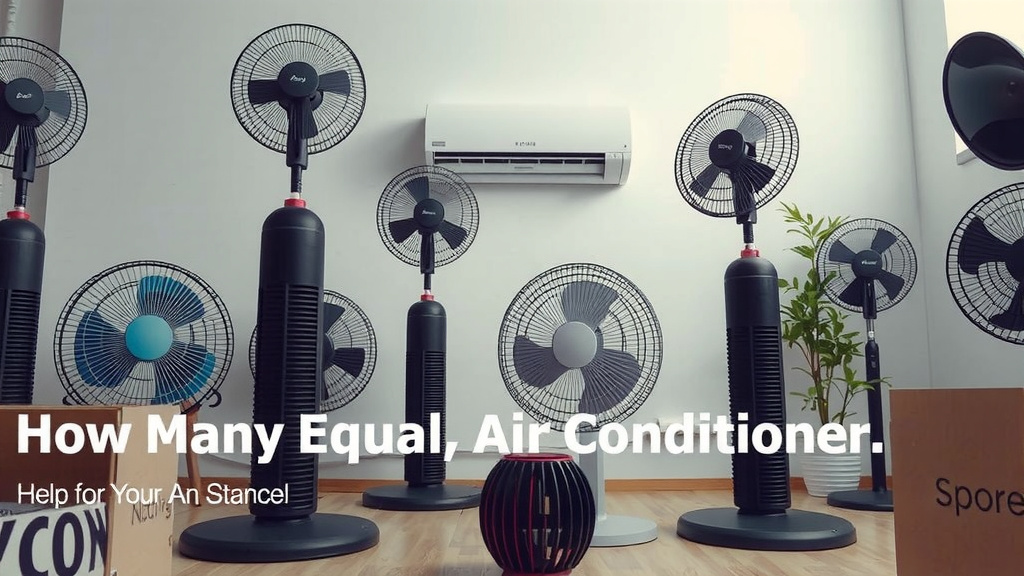
How Many Fans Can *Feel* Like an AC? (With Major Caveats)
This is where the question gets tricky. If you have a very small, well-insulated space, and the outdoor temperature is only slightly elevated, you might achieve a sensation of cooling with several strategically placed fans. Let’s consider a typical bedroom (around 150-200 sq ft).
Simulating Comfort with Multiple Fans
For a single person in a bedroom on a warm (but not hot) day, you might find relief with two high-powered oscillating fans: one aimed at you and another to circulate air towards a window to push out warmer room air. If you have ceiling fans, running them on a medium setting can move a significant amount of air. For example, a standard 52-inch ceiling fan can move about 5,000 cubic feet of air per minute (CFM).
Research has shown that a good ceiling fan can make a room feel 4-8°F cooler. So, if your room is 80°F and feels uncomfortable, a ceiling fan could make it feel like 72-76°F. This is a perceived temperature drop, not an actual one.
The Energy Cost of Fan Overload
Now, imagine trying to achieve that same feeling with portable fans. A typical box fan might move around 2,000 CFM, and a tower fan might be less. To equal the air movement of a few ceiling fans, you’d need several powerful box or tower fans. Running three or four 70-watt box fans continuously uses more electricity than a single 1000-watt air conditioner that cycles on and off.
Plus, as mentioned, the heat generated by the motors of multiple fans can actually add a small amount of heat to the room. So, while you might be moving air, you’re not actively lowering the temperature. Many experts agree that trying to “out-fan” an air conditioner is not a practical or energy-efficient strategy for true cooling.
When You Absolutely Need an Air Conditioner
Here’s a simple checklist to help you decide if fans will cut it, or if it’s time for AC:
- Check the Thermometer: Is it consistently above 85°F?
- Feel the Air: Is it sticky and humid, or dry and warm?
- Listen to Your Body: Are you feeling truly uncomfortable or overheated?
- Consider Health Needs: Are you or someone in your home sensitive to heat?
- Think About Sleep: Can you sleep comfortably without additional cooling?
- Evaluate Long-Term Comfort: Is this a rare hot spell or a frequent summer issue?
If the answer to most of these is leaning towards “yes, it’s very hot and uncomfortable,” then an air conditioner is likely your best bet. Fans are wonderful supplements, but they can’t replace the core function of removing heat. We found that for significant cooling power, an AC unit is still the champion.
Conclusion
So, can multiple fans truly equal an air conditioner? You’ve learned that while fans offer comfort through a wind-chill effect, they don’t actually lower your room’s temperature. Air conditioners, on the other hand, actively remove heat and humidity, providing genuine climate control. Fans are fantastic for mild days and circulating air, especially when used with an AC to raise your thermostat setting. However, when temperatures soar or humidity climbs, fans alone won’t provide the relief you need.
For real cooling power during hot weather, an air conditioner remains your best option. Consider your climate and comfort needs carefully before deciding if fans are enough for your home.
Frequently Asked Questions
How many box fans do I need to cool a room like an AC?
You likely can’t match an AC’s cooling with box fans alone. While multiple fans move air, they don’t reduce temperature. An AC uses a refrigeration cycle to actively cool and dehumidify. Trying to get the same effect with many fans would likely use more energy and still not achieve true temperature reduction.
Can a ceiling fan make a room feel 10 degrees cooler?
Research shows ceiling fans can make a room feel about 4-8°F cooler due to the wind-chill effect on your skin. This is a perceived difference, not an actual drop in air temperature. To feel a true 10-degree difference, you would typically need an air conditioner.
Is running multiple fans better than using a small window AC unit?
For actual cooling and dehumidification, a small window AC unit is generally more effective than multiple fans. Fans only create a breeze, while ACs lower the room’s temperature and remove moisture. Running many fans might use comparable or even more electricity than an efficient AC without delivering the same comfort.
When is it too hot for fans to be effective at all?
Fans become significantly less effective when the outside temperature is consistently above 85°F (29.4°C), especially if the humidity is high. In these conditions, fans will just circulate hot air, and the limited evaporation from your skin won’t provide much relief. An air conditioner is necessary for comfort during true heatwaves.
Can fans increase the temperature in a room?
Yes, fans can slightly increase room temperature. The electric motors in fans generate a small amount of heat as they operate. Running several fans for extended periods can add a minimal amount of heat to the room, counteracting some of the cooling effect from air movement.
![7 Best Midea Portable Air Conditioner [2026]](https://bathroomexplorer.com/wp-content/uploads/2026/06/7-best-midea-portable-air-conditioner-2026-featured-768x432.jpg)