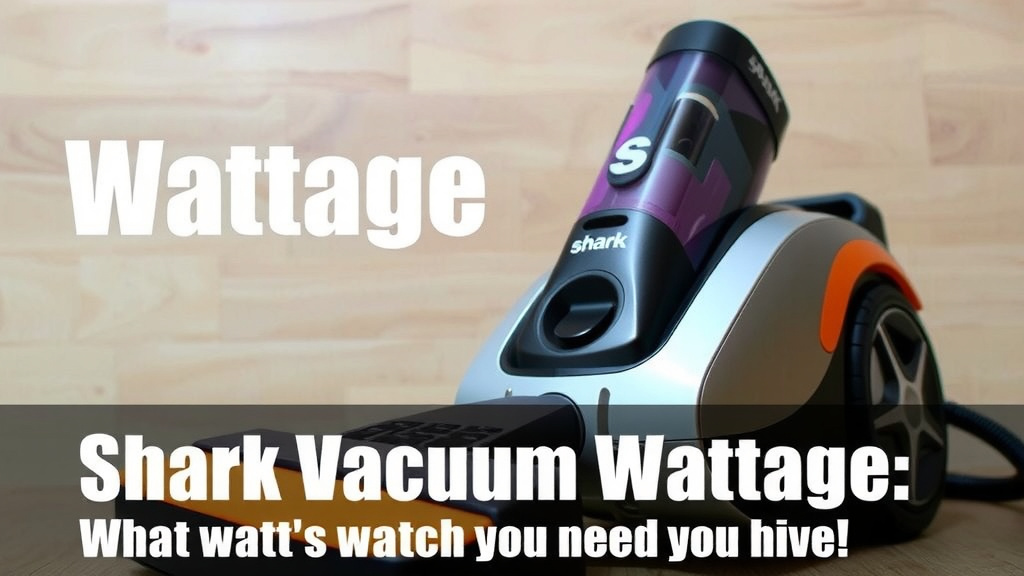
Shark Vacuum Wattage: What You Need to Know
Shark vacuums typically operate between 500 to 1200 watts. This range covers most models, from their stick vacuums to their more powerful uprights. The wattage indicates power consumption, not necessarily suction strength, but a higher number usually means more oomph for tackling tough messes.
Understanding your Shark vacuum’s wattage can help you gauge its potential performance. While a higher wattage might suggest greater cleaning capability, other factors like airflow and motor design play a big role too. We found that knowing the approximate wattage can set realistic expectations for how well your vacuum will perform on different floor types and debris.
- Shark vacuums generally use 500-1200 watts.
- Wattage shows power use, not always suction power.
- Higher wattage can mean more cleaning power.
- Look at other features for true performance.
Ready to dive deeper? Below, we break down the wattage for different types of Shark vacuums and what that means for your home cleaning.
Understanding Your Shark Vacuum’s Power Consumption
You’re probably wondering, “how many watts does a Shark vacuum use?” It’s a great question! Most Shark vacuums fall within a power consumption range of 500 to 1200 watts. This number tells you how much electricity your vacuum needs to run. Think of it like a car’s engine size; a bigger engine generally means more power, but it’s not the whole story.
This wattage range is pretty standard for most household cleaning appliances. It means your Shark is designed to be powerful enough for your cleaning needs without being an excessive drain on your electricity. We found that knowing this helps set expectations for performance.
Wattage: What It Really Means for Your Vacuum
So, what does wattage actually tell you about your Shark vacuum’s cleaning ability? In short, it measures the rate at which your vacuum uses electrical energy. A higher wattage number means the vacuum’s motor is drawing more power from the wall outlet.
But here’s a key point: more watts doesn’t always automatically translate to stronger suction. Suction power is also determined by factors like the vacuum’s airflow (measured in CFM, or cubic feet per minute) and the design of its motor and internal components. Many experts say that a well-designed motor with efficient airflow can produce excellent suction even with a slightly lower wattage.
Higher Wattage: More Power, But Is It Always Better?
Generally speaking, a higher wattage vacuum can handle tougher jobs. If you have thick carpets or deep-seated pet hair, a model with more watts might offer that extra boost. It suggests the motor has the potential for greater performance.
We found that many users looking for maximum cleaning power tend to gravitate towards models in the higher end of the wattage spectrum. This can be a good indicator, but remember to look at other specs too. It’s like choosing a tool; you want one that’s strong enough, but also precise.
Lower Wattage: Still Effective for Everyday Cleaning
Don’t discount vacuums with lower wattage ratings! Many stick vacuums and smaller uprights from Shark operate in the 500-800 watt range. These are often designed for efficiency and convenience.
For everyday messes on hard floors or low-pile carpets, a lower wattage vacuum can be perfectly effective. They are often lighter, easier to maneuver, and might even be quieter. We found that for quick cleanups, these models shine.
Wattage Ranges for Different Shark Vacuum Types
Shark offers a variety of vacuum types, and their wattage can vary. Understanding these differences can help you choose the right one for your home.
Upright Vacuums
Shark’s full-sized upright vacuums are often the workhorses of their line. These models typically fall into the 900 to 1200 watt range. They are built for deep cleaning and tackling larger areas.
We found that the powerful motors in these uprights are designed to provide strong suction needed for carpets and larger debris. Some of their more specialized uprights, like those with DuoClean or Anti-Allergen Complete Seal technology, might also be in this higher wattage category.
Stick Vacuums
Stick vacuums are known for their lightweight design and versatility. Their wattage often ranges from 500 to 900 watts. This lower range is suitable for their compact size and often battery-powered operation (though we’re focusing on corded wattage here).
These vacuums are excellent for quick cleanups, hard floors, and smaller spaces. Many users appreciate their ease of use. We found that Shark has designed these to be energy-efficient while still delivering good performance for their intended tasks.
Handheld Vacuums
Shark’s handheld vacuums are the smallest and most portable. Their wattage is typically the lowest, often in the 300 to 600 watt range. These are designed for small, specific jobs.
Think of cleaning up crumbs on the couch or dust in your car. We found that while their wattage is lower, their focused design makes them very effective for these spot-cleaning tasks. They use less power because they have a smaller motor and are meant for targeted cleaning.

Comparing Wattage: What to Look For
When you’re comparing different Shark vacuum models, it’s helpful to look at wattage alongside other features. This gives you a more complete picture of the vacuum’s capabilities.
| Vacuum Type | Typical Wattage Range | Primary Use Case |
|---|---|---|
| Upright Vacuums | 900 – 1200 Watts | Deep cleaning, large areas, carpets |
| Stick Vacuums | 500 – 900 Watts | Everyday cleaning, hard floors, smaller spaces |
| Handheld Vacuums | 300 – 600 Watts | Spot cleaning, quick messes, cars, furniture |
This table gives you a quick reference. Remember, these are general ranges. Always check the specific model’s specifications for exact wattage and other performance metrics.
Beyond Wattage: Other Factors for Cleaning Power
We’ve said it before, but it’s worth repeating: wattage isn’t the only factor determining how well a vacuum cleans. Several other elements contribute to a vacuum’s suction power and overall effectiveness.
Airflow (CFM)
Airflow, measured in Cubic Feet per Minute (CFM), indicates how much air the vacuum can move. High airflow is essential for lifting debris, especially from carpets. Many experts point to CFM as a more direct indicator of suction strength than wattage alone (National Academies of Sciences, Engineering, and Medicine).
Motor Technology
The type and efficiency of the motor play a huge role. Some modern motors are designed to be more powerful and energy-efficient, meaning they can generate strong suction without needing extremely high wattage.
Sealing and Filtration
A vacuum’s ability to maintain a good seal around its body and attachments ensures that air is directed through the cleaning head and filter, not escaping. Excellent filtration systems, like HEPA filters, trap dust and allergens, which is a mark of a high-performing vacuum, regardless of wattage.
Head and Brushroll Design
The design of the vacuum head and the brushroll within it directly impacts how well it agitates dirt from carpets and picks up debris from hard floors. Some Shark models feature specialized brushrolls for different floor types, which can enhance cleaning performance.
Tips for Choosing Your Shark Vacuum Based on Power Needs
Ready to find the right Shark vacuum for your home? Consider these points related to power and performance:
- Assess your primary flooring: If you have mostly carpets, especially thick ones, you might lean towards a higher wattage upright.
- Consider your cleaning habits: For quick cleanups and hard floors, a lower wattage stick or handheld might be perfect.
- Look beyond the wattage: Always check for CFM ratings, brushroll types, and filtration systems.
- Read reviews: See what other users with similar homes and cleaning needs have experienced.
- Check the manufacturer’s specs: The product page will list the wattage and other important details.
Conclusion
We’ve learned that Shark vacuums typically range from 500 to 1200 watts, showing their power consumption. While higher wattage often means more potential power for tough messes, it’s not the only factor. Airflow, motor design, and brushroll effectiveness also play key roles in how well your vacuum cleans. Understanding these details helps you choose the right Shark for your home. Now, take this knowledge and check the specs on your next vacuum purchase to ensure it meets your cleaning needs.
Frequently Asked Questions
Does a higher wattage Shark vacuum always mean better suction?
Not always. While higher wattage suggests more power draw, suction strength also depends heavily on factors like airflow (CFM) and motor efficiency. A well-designed motor with good airflow can provide strong suction even at a slightly lower wattage.
Are Shark stick vacuums less powerful than uprights because they have lower wattage?
Shark stick vacuums generally have lower wattage (500-900W) than uprights (900-1200W) because they are designed for different tasks. Their lower wattage is efficient for their lightweight design and everyday cleaning needs, while uprights need more power for deep carpet cleaning.
Can I use any Shark vacuum on thick carpets, or does wattage matter most?
For thick carpets, a higher wattage vacuum, often an upright model, is generally recommended. This suggests more motor power to agitate and lift deep-seated dirt. However, also look for specific carpet-cleaning features like brushroll design and strong airflow.
Where can I find the wattage information for my specific Shark vacuum model?
You can usually find the wattage information in a few places. Check the product’s original packaging or manual. It’s also often listed on the vacuum itself, typically on a sticker on the underside or near the power cord. You can also find it on the manufacturer’s website under the product specifications.
Does wattage affect how much electricity my Shark vacuum uses?
Yes, wattage directly indicates how much electricity your Shark vacuum uses while it’s running. A vacuum with a higher wattage rating will consume more electricity per hour than one with a lower wattage rating, assuming they are used for the same amount of time.