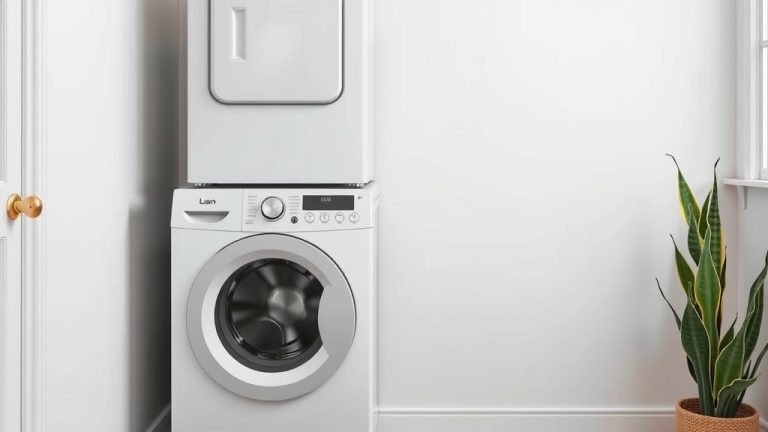
Biggest Stackable Washer Dryer Options for Your Home
When asking about the biggest stackable washer and dryer, it’s important to understand that manufacturers design these units for space efficiency, not maximum capacity. Generally, you’ll find standard-sized machines, around 27 inches wide, that can be stacked. The largest capacity you can expect in a stackable model is typically about 4.5 cubic feet for the washer and 6.0 cubic feet for the dryer, but these are less common.
Most homeowners choose stackable units to fit into smaller laundry rooms or closets. While they offer convenience, the biggest advantage is space-saving. You won’t find commercial-sized giants designed for stacking. Instead, you’re looking at the largest residential options available within the stackable format. We found that balancing capacity and the ability to stack is the main challenge.
- There isn’t one single “biggest” stackable model.
- Standard width is around 27 inches.
- Largest capacities are often around 4.5 cu. ft. (washer) and 6.0 cu. ft. (dryer).
- Stackable units prioritize space over extreme capacity.
Let’s break down what factors you should consider when looking for the largest stackable washer and dryer that fits your needs.
Finding the Widest Stackable Washer and Dryer for Your Home
When you’re looking for the largest stackable washer and dryer, you’re essentially searching for the biggest capacity models that can be safely mounted one on top of the other. It’s a smart way to get more laundry done without sacrificing precious floor space. We found that manufacturers focus on this balance. You’ll discover that while there isn’t one single “biggest” unit universally, certain dimensions and capacities stand out.
Understanding Stackable Unit Dimensions
Most stackable washer and dryer pairs are designed to fit into standard utility closets or alcoves. This means they generally adhere to a common width. We found that the standard width for a stackable unit is typically 27 inches. This is a crucial measurement for fitting the units into your designated space. It’s similar to the width of a standard side-by-side washer and dryer, but by stacking them, you save on the footprint.
The depth and height will vary more between models. You’ll want to measure your laundry space carefully. Check not only the width but also the depth needed for the machines plus any door clearance. Also, consider the height, especially if you have low ceilings or overhead cabinets in your laundry area. Many stackable units reach over 6 feet tall when stacked, so measure your ceiling height!
Depth Considerations
The depth of stackable units is often around 30-34 inches, but this can be deeper if the door protrudes significantly. Always check the manufacturer’s specifications for the exact depth, including the door swing if applicable. We recommend adding a few extra inches for ventilation and hose connections. Proper airflow is essential for efficient drying and preventing overheating.
Height and Stability
The combined height of stacked units can be substantial. Ensure your space can accommodate it comfortably. Most units come with a stacking kit, which is a metal bracket or frame that secures the dryer to the washer. This kit is vital for safety and stability. Without it, the dryer could shift or fall, which is a serious hazard.
Maximum Capacity in Stackable Sets
When we talk about capacity, we’re usually referring to the internal drum size, measured in cubic feet. For stackable units, the capacity is a key factor if you have a large family or handle bulky items like comforters. We found that while they offer more than compact models, they generally don’t reach the massive capacities of full-sized, side-by-side machines.
Washer Capacity in Stackable Units
Many of the larger stackable washers offer a capacity of around 4.5 to 5.0 cubic feet. This is quite generous for a space-saving appliance. It means you can likely wash a week’s worth of clothes for a small family or handle larger loads, like towels and bedding, without issue. We found that models with around 4.5 cu. ft. are more common than those hitting 5.0 cu. ft.
What Can You Fit?
With a 4.5 to 5.0 cubic foot washer, you can typically fit about 10-12 pounds of dry laundry. This translates to several pairs of jeans, a dozen t-shirts, or a queen-size comforter. It’s a good amount for most households. We researched and found that load size is often more about weight than sheer volume, so check your manufacturer’s recommendations.
Dryer Capacity in Stackable Units
Dryer capacities are often slightly larger than their washer counterparts to allow for efficient tumbling and airflow. For larger stackable units, you might find dryer capacities ranging from 6.0 to 7.5 cubic feet. A 6.0 cubic foot dryer is quite capable for most laundry needs. Larger capacities allow clothes to tumble more freely, leading to more even drying.
Maximizing Dryer Efficiency
Just like with the washer, a larger dryer drum means you can dry larger loads. This is especially helpful for bulky items that need space to expand and circulate air. We found that it’s best to avoid overstuffing the dryer. Overloading can lead to longer drying times and wrinkled clothes. Aim to fill it about halfway to two-thirds full for optimal performance.
Factors Beyond Size to Consider
While capacity and dimensions are crucial, other features can make a big difference in your laundry experience. Think about the type of wash cycles you need, energy efficiency, and noise levels. We found that these aspects often go hand-in-hand with larger, more feature-rich models.
Energy Efficiency Ratings
Look for the ENERGY STAR label on both the washer and dryer. ENERGY STAR certified appliances use less energy and water, saving you money on utility bills. This is especially important for units you’ll be running frequently. Many modern stackable units boast impressive energy efficiency. We researched and found that the upfront cost might be slightly higher, but the long-term savings are substantial (ENERGY STAR).
Features for Convenience and Performance
Consider specialized cycles like steam for sanitizing or wrinkle reduction, delicate settings, or quick wash options. Smart features that allow you to control your appliances via a smartphone app can also be a huge convenience. We found that some of the larger, higher-end models include these advanced features.
Here’s a quick checklist to help you find the right fit:
- Measure your laundry space precisely (width, depth, height).
- Check the exact dimensions of any unit you consider.
- Verify that a proper stacking kit is included or available.
- Assess the cubic footage for both washer and dryer drums.
- Look for ENERGY STAR certification for efficiency savings.
- Read reviews to gauge real-world performance and reliability.
Conclusion
Finding the largest stackable washer and dryer means balancing your need for capacity with the essential space-saving benefits. Remember, standard widths of 27 inches are common, with capacities often topping out around 4.5 cubic feet for washers and 6.0 cubic feet for dryers. Don’t forget to measure your space precisely – width, depth, and height are key. Always prioritize safety with a secure stacking kit. Now that you know what to look for, start measuring your laundry space and compare models to find the best fit for your home and laundry needs.
Frequently Asked Questions
Are there any stackable washer and dryer units larger than 27 inches wide?
Generally, no. Manufacturers design stackable units with a standard width of around 27 inches to fit typical alcoves and closets. While some might have slightly different depths or heights, the width is usually consistent for stacking stability and common installation spaces.
Can a king-size comforter fit in a large stackable washer?
A king-size comforter can be a tight fit, even in larger stackable washers with capacities around 4.5 to 5.0 cubic feet. While these are generous for stackable units, bulky bedding items are often best handled by larger, full-sized washers. Check the manufacturer’s load recommendations for specific bedding types.
How much larger is a 6.0 cubic foot dryer compared to a 5.0 cubic foot dryer?
A 6.0 cubic foot dryer offers about 20% more drum volume than a 5.0 cubic foot model. This extra space allows clothes to tumble more freely, leading to more efficient drying and fewer wrinkles. It can be a noticeable difference for larger loads or bulkier items.
Do I really need a special stacking kit?
Yes, absolutely. A stacking kit is a vital safety component that securely fastens the dryer to the washer. Without it, the dryer could shift or even fall, posing a serious hazard. Most manufacturers require their specific kits for warranty purposes.
What’s the difference in capacity between stackable and non-stackable units?
Non-stackable, or full-sized, washers and dryers typically offer larger capacities, often ranging from 5.0 to 6.0 cubic feet for washers and 7.0 to 9.0 cubic feet or more for dryers. Stackable units prioritize space efficiency, so their capacities are generally smaller to allow for stacking.