Best Compact Washer and Dryer Reviews for Your Home
When choosing the best compact washer and dryer, look for models that balance space-saving design with effective cleaning power. You’ll want to consider factors like load capacity, energy efficiency, and specific wash cycles that fit your lifestyle. Many small spaces demand these efficient units without sacrificing performance, and fortunately, many excellent options exist.
Finding the right compact set means understanding your laundry needs and available space. We’ve researched various models to help you navigate options from all-in-one units to stackable pairs. Prioritizing durability and user reviews can also point you toward the most reliable choices for your home.
- Look for washer-dryer combos or stackable units.
- Consider load size and your typical laundry volume.
- Energy efficiency (like ENERGY STAR ratings) saves money.
- Read user reviews for real-world performance insights.
- Check dimensions carefully to ensure a proper fit.
Let’s walk through the key features and considerations to help you pick the perfect compact washer and dryer for your needs. Our guide to washing machine pricing can help you understand the costs involved.
Choosing Your Ideal Compact Laundry Companion
So, you’re on the hunt for a compact washer and dryer that won’t take over your entire living space? You’ve come to the right place! We’ve done the digging to help you find the perfect laundry solution for smaller homes, apartments, or even RVs. The best compact units blend smart design with dependable performance.
Understanding Your Compact Laundry Needs
Washer-Dryer Combo vs. Stackable Units
When we talk about compact laundry, two main types usually come up: the all-in-one washer-dryer combo and the stackable washer and dryer sets. Each has its own charm and set of benefits.
The All-in-One Washer-Dryer Combo
Think of this as your space-saving superhero. A combo unit does both washing and drying in a single machine. You load your clothes, select your cycle, and walk away. It washes, then it dries. This is fantastic if you have very limited floor space. Some models even let you wash a load while the previous one is drying, though this can take longer.
We found that these units are great for singles or couples. They are often energy-efficient, which is a nice bonus for your utility bills. However, their drying capacity is typically smaller than their washing capacity. You might need to remove some items before the drying cycle for optimal results.
Stackable Washer and Dryer Sets
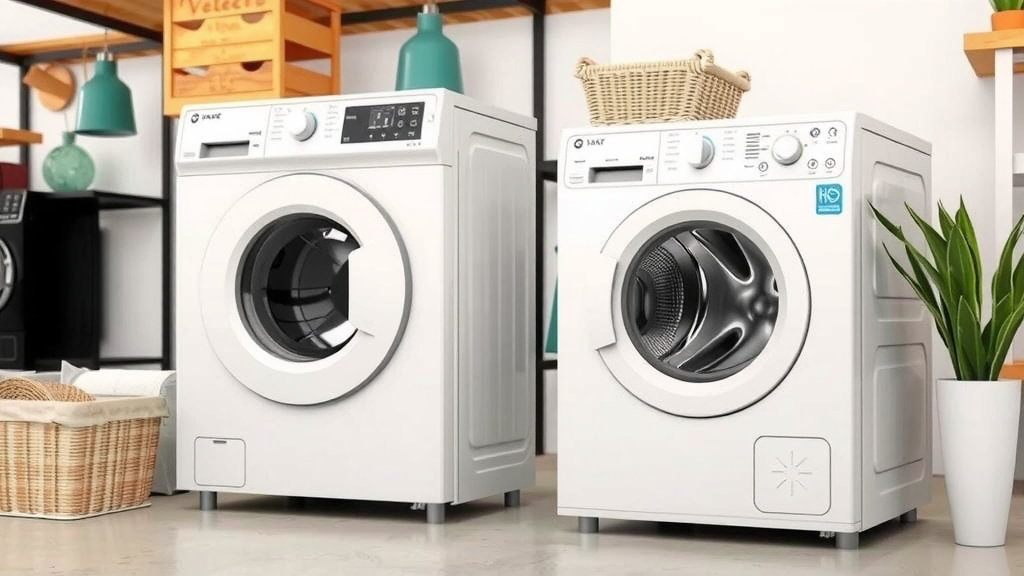
These are two separate units – a washer and a dryer – designed to be placed one on top of the other. This setup requires a bit more vertical space but gives you more flexibility. You get the full washing capacity of a standard washer and the full drying capacity of a standard dryer. This is a big win if you do larger loads or have a family.
You’ll need to ensure your ceiling height is adequate. Many people opt for stackable units because they can often handle larger wash loads than combos. They can also be more efficient for drying. We also noted that they might offer a wider range of specialized wash and dry cycles.
Key Features to Look For
Beyond the type of unit, several features can make or break your laundry experience. Let’s break them down.
Capacity: How Much Can It Hold?
Compact doesn’t mean tiny! Even small machines come in different capacities. Measure your typical laundry load. A single person might be fine with a 2.0 cubic feet capacity. A couple might need 2.5 cubic feet or more. Families may need to lean towards stackable units for larger loads.
It’s easy to get caught up in the “smallest is best” idea, but too small can mean doing laundry every day. We found that a slightly larger capacity, if it fits your space, can save you a lot of time and effort in the long run. Always check the manufacturer’s specifications for exact load sizes.
Energy Efficiency: Saving Green While Going Green
This is huge! Look for the ENERGY STAR certification. These appliances are independently certified to be more energy-efficient than standard models. This means lower electricity and water bills. Over the life of the appliance, this can add up to substantial savings.
Many compact models are designed with efficiency in mind from the start. Some even use sensors to detect load size and adjust water and energy use accordingly. We think this is a smart feature for any laundry appliance.
Wash and Dry Cycles: Does It Meet Your Needs?
Do you have delicate items? Heavy-duty work clothes? Frequent bedding loads? Ensure the machine has the cycles you need. Look for features like steam cycles for sanitizing or wrinkle reduction, quick wash options for when you’re in a hurry, and specialized cycles for delicates or bulky items.
For dryers, consider options like moisture sensors. These stop the dryer when clothes are perfectly dry, preventing over-drying and saving energy. We found that models with these advanced sensors often lead to better fabric care.
Noise Level: Can You Live With It?
If your laundry area is close to your living space, noise can be a big issue. Many manufacturers now include features to reduce vibration and noise. Look for models that mention “quiet operation” or have anti-vibration technology. Reading user reviews can give you a real sense of how noisy a machine truly is.
We found that some machines are surprisingly quiet, almost like a gentle hum. Others can sound like a jet engine preparing for takeoff. If sound is a concern, prioritize models with noise-reduction features.
Comparing Popular Compact Washer and Dryer Options
While “the best” is subjective, we can look at some common types and features that consistently get good marks. Think of this as a quick guide to what’s out there.
| Feature | Washer-Dryer Combo | Stackable Washer & Dryer |
|---|---|---|
| Space Efficiency | Excellent (single unit) | Good (vertical space) |
| Capacity | Often smaller, especially for drying | Generally larger, more consistent |
| Drying Performance | Can be slower, smaller loads | Faster, full loads |
| Installation | Usually simpler hookups | Requires stacking kit, potentially more complex |
| Cost | Can be higher upfront for advanced models | Variable, depends on individual units |
This table gives you a general idea. Always check the specific model’s reviews and specs.
Checklist for Your Perfect Compact Laundry Fit
Before you click “buy,” run through this quick checklist:
- Measure your space (height, width, depth).
- Confirm water and electrical hookup locations.
- Estimate your typical laundry load size.
- Prioritize needed wash/dry cycles.
- Check for ENERGY STAR certification.
- Read recent user reviews for performance feedback.
Conclusion
Finding the best compact washer and dryer for your home is all about balancing your space limitations with your laundry needs. We’ve seen that whether you opt for a space-saving all-in-one combo or a versatile stackable set, careful consideration of capacity, energy efficiency, and cycle options is key. Remember to measure your space accurately and read real user reviews to ensure you make a choice that simplifies, rather than complicates, your laundry routine. Your next step is to use your measurements and prioritized features to compare specific models and find the perfect fit.
Frequently Asked Questions
Are compact washer and dryer combos worth the higher cost?
Many compact combos can have a higher upfront cost than basic standalone units. However, their dual functionality in a single footprint saves significant space, which can be invaluable in apartments or small homes. We found that the energy efficiency often built into these units can also lead to long-term savings on utility bills.
How often do I need to clean a compact washer-dryer combo?
You should clean your compact combo unit regularly, similar to a standard machine. This includes wiping down the door seal, cleaning the detergent dispenser, and running a cleaning cycle with a specialized washer cleaner monthly. For the dryer function, regularly clear lint from the filter to ensure optimal performance and safety.
Can a compact dryer handle bulky items like comforters?
Generally, compact dryers, especially those within all-in-one combos, have smaller drums and may struggle with bulky items. We advise checking the specific model’s capacity; many suggest avoiding washing and drying very large items like comforters. Stackable units often offer more capacity for such loads.
What are the typical dimensions of a compact washer and dryer?
Compact washer and dryer dimensions can vary, but they are typically around 24 inches wide. Height can range from 30 to 35 inches for front-load models and significantly more for stackable units. Depth is usually between 25 to 30 inches. Always measure your intended space, including doorways and installation paths.
Is it better to get a separate compact washer and dryer or a combo?
It depends on your priorities. If maximizing floor space is your absolute top concern and you do smaller loads, a combo unit is excellent. If you tend to do larger loads, have more vertical space, and want potentially faster drying times, a stackable set might be a better fit. We researched that stackable units also often offer more wash cycle variety.