How Long Can I Leave an Air Purifier On? A Comprehensive Guide
Is it okay to run your air purifier 24/7, or should you switch it off periodically? This is a common dilemma for many homeowners. You’ve likely invested in an air purifier to improve your indoor air quality, but knowing the most effective way to use it can be confusing. While continuous operation isn’t inherently problematic, there are important points to weigh before committing to 24/7 use.
Think of your air purifier like a security guard for your home—it’s designed to work whenever pollutants are present. But just like any appliance, there are optimal ways to use it that will maximize benefits while minimizing costs and maintenance headaches. In this guide, I’ll walk you through everything you need to know about running your air purifier safely and efficiently.
Understanding How Air Purifiers Actually Work
Before we dive into how long you can leave your air purifier running, let’s talk about what these devices actually do. Air purifiers work by pulling air through a series of filters that trap particles like dust, pollen, pet dander, and other pollutants. The cleaned air then gets released back into your room, and the cycle repeats.
Most modern air purifiers are equipped with HEPA filters, which can capture up to 99.97 percent of particles that are 0.3 micrometers or larger. Some models also include activated carbon filters to handle odors and volatile organic compounds. Understanding this mechanism helps explain why your purifier might benefit from extended operation, especially in environments where pollution levels are consistently high.
The key thing to remember is that air purifiers don’t clean the air once and then stop working. They continuously filter incoming air, which means the longer they run, the more effective they become at maintaining clean air quality in your space.
What Do Manufacturers Actually Recommend?
Here’s where things get interesting. Most air purifier manufacturers design their products to run continuously without issues. When you look at the instruction manuals for premium brands, you’ll typically find that they’re built for 24/7 operation. This is because air purifiers are essentially designed like HVAC systems—they’re meant to work as long as needed to maintain air quality.
That said, manufacturers do recommend regular maintenance, which includes:
- Checking filters monthly for dust accumulation
- Replacing filters according to usage patterns (typically every 6 to 12 months)
- Cleaning pre-filters if your model includes them
- Ensuring proper ventilation around the unit
- Keeping the intake and output vents unobstructed
The consensus among most reputable manufacturers is clear: you can leave your air purifier on for as long as you want, provided you maintain it properly. The real limitation isn’t the device itself—it’s the filter’s ability to continue capturing pollutants effectively.
Continuous Operation Versus Intermittent Use: Which Is Better?
Now let’s address the elephant in the room. Should you run your air purifier all day and night, or is it better to use it strategically?
The Case for Continuous Operation
Running your air purifier continuously offers several advantages. First, it provides constant protection against airborne pollutants. If you live in an urban area with high traffic pollution, or if you have family members with allergies or asthma, continuous operation ensures that harmful particles are continuously being removed from your breathing space.
Additionally, continuous operation prevents the reaccumulation of pollutants. Think of it this way: every time you turn off your purifier, particles that have settled on surfaces can become airborne again through normal activities like walking or sitting down. Keeping the purifier running minimizes this problem.
The Case for Intermittent Use
On the other hand, running your air purifier intermittently can extend filter life and reduce electricity costs. If your home environment is relatively clean, or if you’re primarily concerned about specific times of day (like when outdoor pollution is highest), you might get by with running your purifier for 8 to 12 hours daily.
Many people use this hybrid approach: running their purifiers on high speed during peak pollution hours and on lower settings during nights, or turning them off entirely during certain seasons when air quality is naturally better.
How Filter Lifespan Affects Your Usage Plans
Here’s something that often surprises people: the longer you run your air purifier, the faster your filters will need replacement. This is actually straightforward physics. Filters accumulate more particles the more air they process, so continuous operation will reduce filter lifespan compared to intermittent use.
Most HEPA filters last between 6 and 12 months of regular use, but this can vary significantly based on:
- How many hours per day the purifier operates
- The pollution level in your environment
- Whether you have pets that shed fur and dander
- Local air quality conditions and seasonal changes
- The quality of the filter itself
If you run your purifier 24 hours a day in a dusty environment, you might need to replace filters every 3 to 4 months. Conversely, if you use it 4 hours daily in a relatively clean space, a filter might last a year or longer. It’s important to check your filters regularly rather than just relying on recommended timelines.
Energy Consumption: What Will This Cost You?
Let’s talk money. Air purifiers consume electricity, and leaving one running continuously will definitely show up on your power bill. However, the amount depends on several factors.
Most air purifiers consume between 30 to 200 watts per hour, depending on the model and fan speed. A typical mid-range purifier might use about 75 watts on medium setting. If you run this for 24 hours daily for a month, that’s approximately 54 kilowatt-hours monthly.
At the average US electricity rate of around $0.14 per kilowatt-hour, you’d be looking at roughly $7 to $8 per month for continuous operation of a mid-range unit. Over a year, that’s under $100, which many people find acceptable for the health benefits they gain.
However, if you’re using a high-powered air purifier or if your local electricity rates are higher, continuous operation could cost $150 to $300 annually. This is where the intermittent approach might make more financial sense for your household.
Indoor Air Quality: How It Influences Your Decision
The real answer to how long you should run your air purifier depends largely on your specific air quality situation. Are you dealing with constant pollution sources, or is your air generally clean with occasional pollutant spikes?
If you’re in a situation with persistent air quality issues, such as:
- Living near busy highways or industrial areas
- Having family members with severe allergies or respiratory conditions
- Living in a region with frequent wildfires or poor AQI readings
- Sharing your space with multiple pets
- Living with smokers or using certain hobbies that create particles
Then continuous operation becomes more justified. Your air purifier becomes like a medical device—necessary for health and wellness rather than just a convenient appliance.
Conversely, if your area has generally good air quality and you’re using the purifier mainly as a precaution or for seasonal issues, running it 8 to 12 hours daily might be perfectly adequate.
The Health Benefits of Running Your Purifier Longer
One of the strongest arguments for extended air purifier operation is the health impact. Research has consistently shown that poor indoor air quality contributes to respiratory issues, allergies, asthma exacerbation, and even cardiovascular problems over time.
When you run your air purifier longer, you’re reducing your exposure to:
- Fine particulate matter (PM2.5 and PM10)
- Allergenic particles like pollen and dust mites
- Pet dander and mold spores
- Volatile organic compounds from furniture and cleaning products
- Bacteria and viruses suspended in the air
For people with asthma or allergies, even a small improvement in air quality can make a measurable difference in symptoms and quality of life. If you fall into this category, the cost and filter replacement inconvenience of continuous operation suddenly seem trivial compared to the health benefits.
Noise Levels: Is 24/7 Operation Realistic for You?
Here’s a practical consideration that often gets overlooked: noise. Air purifiers produce sound, and running one continuously means you’re living with that noise around the clock. The noise level varies dramatically between models.
Budget air purifiers might produce 60 to 70 decibels on high speed, which is comparable to a conversation or office noise. Premium models can be as quiet as 25 to 35 decibels on low speed, which is barely noticeable.
If you’re considering continuous operation, especially in your bedroom, invest in a quieter model. Many people find that using a quieter purifier on medium speed continuously is better than running a loud unit intermittently on high speed. Modern air purifiers with smart features can also automatically adjust speeds based on detected air quality, allowing for quieter operation during sleeping hours.
Maintenance Requirements for Long-Term Operation
Keeping your air purifier running for extended periods requires commitment to maintenance. You can’t just turn it on and forget about it.
Monthly Maintenance Tasks
Check your pre-filter and HEPA filter visually for dust accumulation. If the pre-filter looks heavily soiled, you can vacuum it gently (on some models) or replace it. Most pre-filters can be cleaned and reused, which saves money compared to HEPA filters.
Quarterly Tasks
Deep clean the unit’s exterior and intake vents. Dust buildup around the intake can reduce efficiency. Use a slightly damp cloth to wipe down the exterior, and ensure nothing is blocking the air intake areas.
Biannual or Annual Tasks
Replace the HEPA filter based on how often you’ve run the unit and its condition. Don’t wait for it to get completely clogged—filter efficiency drops as they get dirtier. If you’re running your purifier 24/7 in a dusty environment, you might need to replace filters every 3 to 6 months instead of the standard 12 months.
Neglecting maintenance while running your purifier continuously is like running a car without oil changes—it’ll work for a while, but eventually, efficiency drops and problems develop.
Room Size and Purifier Type Matter More Than You Think
The relationship between your room size and your air purifier’s CADR (Clean Air Delivery Rate) affects how long you actually need to run it.
If you have a high-CADR purifier in a small room, it might clean the entire room’s air multiple times per hour. This means it can be very effective with intermittent use—running for just 2 to 3 hours might thoroughly purify a small bedroom.
Conversely, if your purifier is undersized for your room, you’ll need longer operating hours or continuous operation to achieve meaningful air quality improvement. Using a purifier that’s too small for your space and relying on intermittent operation is like using a bucket to bail out a flooding basement—it just won’t work well enough.
Always match your purifier’s CADR rating to your room size. Most manufacturers provide recommendations like “suitable for rooms up to 400 square feet.” If your room is larger than recommended, either upgrade the purifier or accept that you’ll need continuous or longer operating hours.
When Should You Actually Turn Off Your Air Purifier?
Despite all the benefits of continuous operation, there are legitimate reasons to turn off your air purifier occasionally.
During High Pollen or Pollution Events
Counterintuitively, during extreme pollution events—like heavy wildfire smoke or high pollen days—you might want to run your purifier continuously rather than turning it off. This is exactly when you need the protection most.
When You’re Away from Home
If nobody’s home, there’s less reason to run your purifier. You’re not breathing the air, and particles take longer to accumulate without human activity. Turning it off while away can save energy without compromising your indoor air quality during the hours you’re actually there.
During Maintenance or Filter Replacement
Obviously, you need to turn it off when changing filters or cleaning the unit.
If Noise Becomes Problematic
If you have a particularly noisy unit and continuous operation is affecting your sleep quality, it’s better to turn it off at night and run it during the day rather than suffer poor sleep—poor sleep has its own health consequences.
Seasonal Usage Patterns and Air Quality Variations
Air quality isn’t constant throughout the year. Many regions experience seasonal variations in pollution, pollen, and overall air quality.
In spring, high pollen counts might warrant continuous operation if you suffer from allergies. In summer, air quality might improve in some regions while others face wildfire smoke. Fall often brings leaf mold and allergens. Winter pollution depends on heating methods and local weather patterns.
Rather than using a one-size-fits-all approach, consider adjusting your purifier operation based on seasonal air quality. Check your local Air Quality Index (AQI) regularly and adjust accordingly. On days when AQI is in the “good” category, you might reduce operation hours. On “unhealthy” days, run continuously.
Smart Features Make Extended Operation Easier
Modern air purifiers increasingly come with smart features that optimize operation automatically. Air quality sensors can detect pollutant levels and adjust fan speed accordingly, automatically increasing to high speed when pollution spikes and reducing to low speed when air is clean.
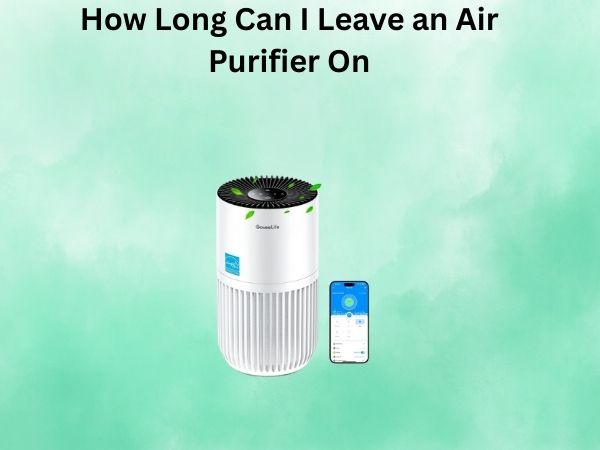
This means you can leave your purifier on “auto” mode continuously, and it will use energy efficiently, only running on high speed when necessary. Some models even connect to smartphone apps, allowing you to monitor air quality and control the purifier remotely.
Timer functions let you schedule operation around your daily routine. Sleep mode features reduce noise during nighttime hours. These smart features make the question of “how long to run it” easier by letting the purifier decide based on real-time air quality data.
If you’re buying a new air purifier and considering extended operation, prioritizing a model with smart features could be one of the best investments you make.
Conclusion
So, how long can you leave your air purifier on? The honest answer is: as long as you need to. Your air purifier is built to handle continuous operation, and there are no technical limitations preventing you from running it 24/7. The real question isn’t about capability—it’s about your specific situation.
Consider these factors when making your decision: your indoor air quality situation, health needs of household members, local pollution levels, energy costs in your area, and the noise tolerance in your living space. For someone with severe asthma living near a busy highway, continuous operation is clearly the right choice. For someone in a clean suburban area without allerg