How to Calculate the Pressure of Water: A Complete Guide for Beginners
Have you ever wondered why water shoots out forcefully from a fire hose but gently trickles from a kitchen faucet? The answer lies in water pressure, one of those fascinating physics concepts that actually affects our daily lives in ways we rarely think about. Whether you’re a homeowner dealing with plumbing issues, a student tackling physics homework, or simply curious about how the world works, understanding how to calculate water pressure is more practical than you might imagine.
Think of water pressure like the invisible force pushing water through pipes and systems. It’s the same principle that allows water to reach the top floors of tall buildings or provides the power for water fountains and jets. In this guide, I’m going to walk you through everything you need to know about calculating water pressure, from the basic concepts to practical applications you can actually use.
Understanding the Fundamentals of Water Pressure
Before we jump into calculations, let’s establish what water pressure actually is. Water pressure is the force exerted by water on the walls of its container or the surfaces it flows against. It’s measured in units like pounds per square inch (PSI), pascals (Pa), or bars, depending on where you live and what field you’re working in.
Picture water molecules constantly moving and colliding with each other and the surfaces around them. These countless tiny collisions create pressure. The deeper you go into water, the more weight of water sits above you, resulting in greater pressure. This is why it feels uncomfortable when you dive deep in a swimming pool—that’s water pressure at work.
The Basic Formula for Water Pressure
The fundamental equation for calculating water pressure is straightforward and elegant. Here’s what you need to know:
Pressure = Force ÷ Area
Or in more specific terms for fluids:
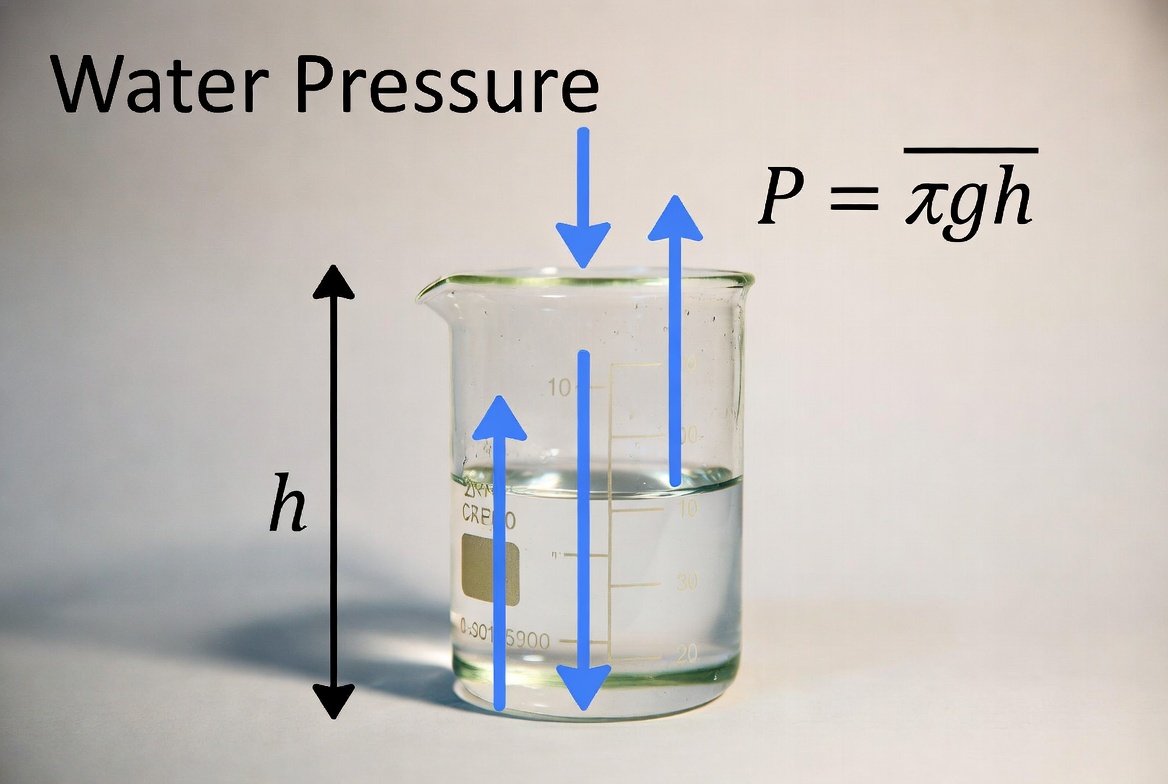
P = ρgh
Let me break this down for you:
- P represents pressure
- ρ (rho) is the density of water
- g is the acceleration due to gravity
- h is the height or depth of the water column
This formula is absolutely crucial because it shows that water pressure depends on three things: how dense the water is, gravity’s pull, and how much water is above a given point. If any of these changes, so does the pressure.
The Role of Density in Water Pressure Calculations
Why Density Matters
Density is essentially how much “stuff” is packed into a certain amount of space. For water, we typically use a density of about 1000 kilograms per cubic meter or 1 gram per cubic centimeter at room temperature. However, this value can vary slightly depending on temperature and salinity.
Think about it this way: if you had the same volume of oil and water, the water would be denser and create more pressure because more mass is packed into the same space. This is why calculations using freshwater might differ slightly from calculations using saltwater, where density can be around 1025 kg/m³.
Temperature Effects on Density
Water behaves oddly compared to most substances. As water gets colder, it usually becomes denser, except near freezing point where it actually becomes less dense. This is why ice floats. For practical calculations in normal conditions, you can stick with the standard density value, but it’s worth knowing this information if you’re dealing with extreme temperatures.
Gravity’s Influence on Water Pressure
The constant g in our formula represents gravity, approximately 9.8 meters per second squared on Earth’s surface. This is the acceleration that gravity imparts to falling objects and, by extension, to the water column above any given point.
Here’s the interesting part: gravity is what makes the water press down in the first place. Without gravity, water would float around in space without creating any pressure. The stronger the gravitational pull, the greater the pressure. This is why pressure calculations might differ on the Moon compared to Earth, though you’re unlikely to be calculating water pressure there anytime soon.
Measuring Water Depth and Height
The Importance of Vertical Distance
The height component of our formula refers to the vertical distance of the water column above the point where you’re measuring pressure. This is crucial: it’s not about the total length of a pipe or the distance traveled horizontally, but specifically the vertical drop.
Imagine a pipe that goes horizontally for 100 feet and then drops down 10 feet. The pressure at the bottom depends only on that 10-foot vertical drop, not the 100-foot horizontal stretch. This distinction trips up many people when they first start calculating water pressure.
Converting Height Measurements
You might encounter height measurements in feet, inches, meters, or centimeters depending on your region and source. Here’s what you need to remember:
- 1 meter equals approximately 3.28 feet
- 1 foot equals approximately 0.305 meters
- 1 inch equals approximately 0.0254 meters
- Always convert to the same units before calculating
Step-by-Step Calculation Process
Basic Calculation Example
Let’s work through a practical example. Suppose you want to know the pressure at the bottom of a 5-meter deep pool filled with freshwater.
Using our formula P = ρgh:
- ρ = 1000 kg/m³ (density of freshwater)
- g = 9.8 m/s² (gravity)
- h = 5 meters (depth)
P = 1000 × 9.8 × 5 = 49,000 pascals, or about 49 kPa
To convert this to PSI (which you might be more familiar with), divide by 6.895:
49,000 ÷ 6,895 = approximately 7.1 PSI
Working with Multiple Water Columns
What happens when you have more complex systems with water at different heights? You calculate the pressure at each point and then add them together. This is particularly relevant in plumbing systems where water might flow through multiple levels of a building.
Understanding Gauge Pressure vs Absolute Pressure
The Difference Between the Two
Here’s where things get a bit more nuanced. There are actually two ways to measure pressure, and they’re not the same thing.
Absolute pressure is measured from a perfect vacuum, which is zero pressure. Gauge pressure is measured relative to atmospheric pressure. Most everyday pressure measurements you’ll encounter, like PSI readings on a tire gauge, are actually gauge pressure.
The relationship is simple:
Absolute Pressure = Gauge Pressure + Atmospheric Pressure
At sea level, atmospheric pressure is about 101.3 kPa or 14.7 PSI. So if your tire gauge reads 32 PSI, the absolute pressure is actually 32 + 14.7 = 46.7 PSI.
Which One Should You Use?
For most practical water pressure calculations involving plumbing systems and tanks, you’ll want to use gauge pressure. That’s what most pressure gauges and instruments measure anyway. However, for theoretical physics problems or atmospheric calculations, absolute pressure becomes important.
Pressure at Different Depths in Water
Creating a Pressure Table
It’s helpful to understand how pressure increases with depth. Using our formula, here’s what the pressure looks like at various depths in a freshwater body:
- At 1 meter depth: approximately 9.8 kPa or 1.42 PSI
- At 5 meters depth: approximately 49 kPa or 7.1 PSI
- At 10 meters depth: approximately 98 kPa or 14.2 PSI
- At 20 meters depth: approximately 196 kPa or 28.4 PSI
- At 50 meters depth: approximately 490 kPa or 71 PSI
Notice the pattern? Pressure increases linearly with depth. Double the depth, and you double the pressure. This consistent relationship makes calculations predictable and manageable.
Real-World Applications of Water Pressure Calculations
Residential Plumbing Systems
If you live in a multi-story house, water pressure plays a vital role in getting water to your upper floors. Most residential systems maintain water pressure between 40 and 80 PSI. If your pressure is too low, showers feel weak. Too high, and you risk damaging pipes and fixtures. Calculating the pressure loss from your main water line to the second floor helps determine if you need a pressure booster pump.
Water Tank Design
Engineers designing water storage tanks must calculate the pressure that the tank walls will experience. A tank that’s 10 meters tall will exert significant pressure at its base, requiring stronger materials and construction at the bottom. This is why large water towers have thicker walls near the ground.
Swimming Pool and Spa Systems
Pool pumps need to be sized appropriately for the depth of the pool. The deeper the pool, the more pressure is generated, which affects pump selection and filtration system design. This is why Olympic-sized pools require different equipment than residential pools.
Fountain Design
Those beautiful water fountains you see in parks? The height that water can shoot up depends on the pressure in the system. Using water pressure calculations, designers determine pump specifications to achieve the desired fountain effects.
Factors That Affect Water Pressure Beyond Depth
Temperature Variations
While we mentioned density changes with temperature, it’s worth noting that temperature affects the entire water system. Heated water expands slightly, which can increase pressure in closed systems. This is why expansion tanks are installed in residential heating systems.
Salinity and Dissolved Solids
Saltwater has a higher density than freshwater, so it creates more pressure at the same depth. If you’re calculating pressure for seawater or brackish water, adjust your density value accordingly. This becomes important in industrial applications and marine engineering.
Water Movement and Velocity
When water is flowing, additional pressures come into play beyond simple static pressure. Bernoulli’s principle describes how moving water creates different pressures along its path. However, for basic static pressure calculations, we ignore these dynamic effects.
Common Mistakes When Calculating Water Pressure
Confusing Height with Distance
The most frequent error people make is using the total distance a pipe travels rather than the vertical height. Remember, only vertical distance matters for hydrostatic pressure calculations. A horizontal pipe 100 feet long but at the same elevation creates no additional pressure difference.
Forgetting Unit Conversions
Mixing units is another common pitfall. If you use height in feet but density in kg/m³, your answer will be nonsense. Always convert everything to consistent units before calculating. Keep a conversion chart handy when you’re starting out.
Ignoring Atmospheric Pressure
When dealing with real-world measurements, remember that atmospheric pressure acts on the water surface. Most practical measurements account for this automatically, but it’s important to understand whether you’re working with gauge or absolute pressure.
Tools and Instruments for Measuring Water Pressure
Pressure Gauges
The most direct way to verify your calculations is with a pressure gauge. Mechanical gauges are affordable and reliable for most applications. Digital gauges offer more precision and sometimes additional features. For underwater applications, specialized depth gauges measure pressure at various depths.
Manometers
A U-tube manometer uses the height of a liquid column to measure pressure. It’s a simple device that directly demonstrates our P = ρgh principle in action. Water manometers work well for small pressures, while mercury manometers handle larger pressures more compactly.
Advanced Calculations and Scenarios
Pressure in Non-Vertical Configurations
What if your water container isn’t a simple vertical tank? The key principle remains: only the vertical distance matters. In any configuration—whether it’s a bent pipe or an irregular container—measure the vertical distance from the surface to your point of interest.
Pressure Loss in Pipes
In real plumbing systems, water pressure decreases as it flows through pipes due to friction. This pressure loss depends on pipe diameter, water velocity, pipe length, and surface roughness. Calculating this requires more complex formulas, but the hydrostatic pressure calculation we’ve learned provides the baseline.
Conclusion
Calculating water pressure might have seemed intimidating at first, but as you’ve seen throughout this guide, it boils down to a simple, elegant formula: P = ρgh. Understanding that pressure depends on the density of water, gravity’s pull, and the vertical height of the water column gives you the foundation to solve countless practical problems.
Whether you’re troubleshooting low water pressure in your home, designing a pool system, or just satisfying your curiosity about how the physical world works, you now have the tools and knowledge to calculate water pressure accurately. Remember to pay attention to your units, focus on vertical distance rather than total distance, and understand whether you’re working with gauge or absolute pressure.
The beauty of this calculation is its simplicity combined with its profound real-world applications. From the water reaching your shower on the second floor to the depths of the ocean, water pressure follows these same principles. Keep this formula in your toolkit, and you’ll find yourself understanding and solving water pressure problems with confidence and ease.
Frequently Asked Questions
What is the difference between water pressure and water flow rate?
Water pressure and flow rate are different concepts that sometimes get confused. Pressure is the force exerted by water, measured in PSI or pascals, while flow rate is the volume of water moving past a point per unit time, measured in gallons per minute or liters per second. You can have high pressure with low flow or low pressure with high flow depending on the system design. Think of it like a garden hose: pressure is how hard the water pushes, while flow rate is how much water comes out.
Can I calculate water pressure if the water is moving?
The basic hydrostatic pressure formula P = ρgh applies to stationary water. When water is moving, additional dynamic pressures come into play, governed by Bernoulli’s principle. However, for most practical applications like plumbing systems, the static pressure calculation gives you a good approximation, especially if the water velocity is relatively low. For high-speed flows or precise engineering applications, you’d need to account for dynamic pressure separately.
Why does water pressure increase with depth even though the water isn’t moving?
This comes down to the weight of water above pushing down. Imagine a stack of blocks: the blocks at the bottom experience more compression because they’re supporting everything above them. Water works the same